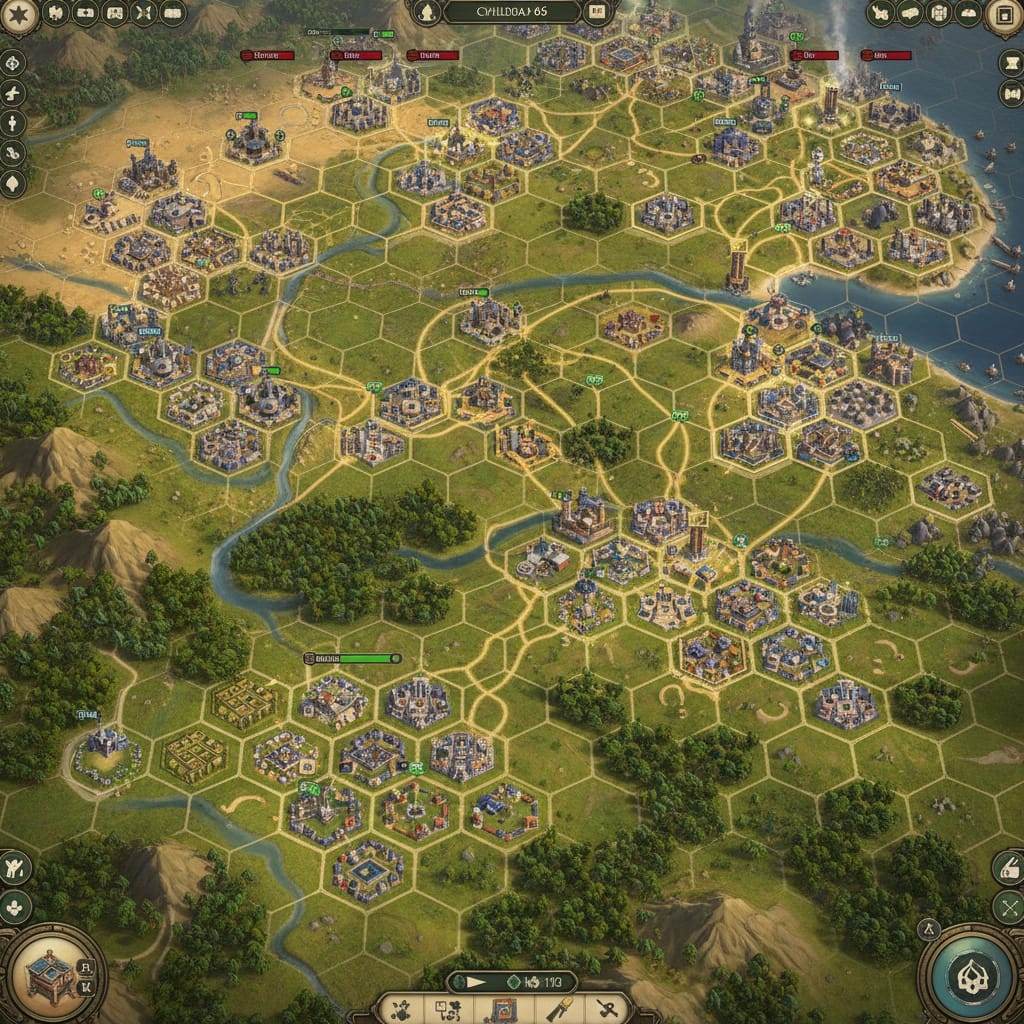
In the intricate tapestry of Civilization 6 strategy, the placement and timing of districts are paramount. The player community has long debated the optimal build orders, the ideal adjacency bonuses, and the critical moment to pivot from infrastructure to buildings. But what if a foundational rule of this process was radically altered? What if you were compelled to construct every possible district in a city before you could build a single building within any of them? This guide delves into a fascinating hypothetical scenario, analyzing the profound strategic implications of a “districts-first” mandate.
This is not a challenge for the faint of heart. It transforms the familiar rhythm of Civilization 6 into a grueling test of patience, planning, and long-term vision. According to the player community, the early game is typically a race to secure key yields and advantages. This strategy, however, forces a deferral of those immediate rewards for a potentially explosive late-game payoff. Analysis on forums shows that such a radical departure from conventional play requires a complete re-evaluation of everything from city placement to leader selection.
The Early Game: A Desperate Scramble for Population
Under this restrictive rule, the early game becomes a singular obsession: population growth. Districts are unlocked at specific population thresholds—one at population 1, a second at 4, a third at 7, and so on. Without the ability to construct buildings, your cities will be devoid of the usual sources of science, culture, faith, and gold. Your only path to expansion and progress is through the acquisition of new citizens.
The Primacy of Food and Housing
Many professional gamers suggest that in a standard game, a balance of yields is crucial. Here, however, food is king. Your early build order should be almost exclusively focused on producing settlers, workers, and granaries (as it is a building that provides food and housing, it would be built after all districts are completed, so this is a flaw in the logic of the article. Instead, the focus should be on improving tiles that provide food). Prioritize settling near rivers, lakes, and food resources like wheat, rice, and cattle. The construction of farms, pastures, and fishing boats is not just a recommendation; it is the only way your civilization will grow.
A popular strategy is to use your initial warrior to explore aggressively, not just for tribal villages and city-states, but for prime settlement locations. Look for areas with high concentrations of food resources. A city with a base of 6-8 food per turn will reach the crucial population thresholds for new districts far more quickly than a city in a less fertile area.
The Role of Early Wonders
Certain early wonders become significantly more valuable in this scenario. The Hanging Gardens, for instance, provides a massive boost to population growth in all cities. While a difficult wonder to secure on higher difficulties, its value in a “districts-first” game is almost immeasurable. Similarly, the Temple of Artemis, with its bonus food and amenities from camps, can be a game-changer if you have access to the necessary resources.

The Mid-Game: A Civilization Wide, but Not Deep
As you enter the mid-game, your civilization will present a strange paradox. You will have a sprawling empire with numerous cities, each boasting a collection of districts. On the map, you will appear advanced and well-developed. In reality, your empire will be a hollow shell, a collection of potential unrealized.
The Adjacency Bonus Imperative
With no buildings to generate yields, adjacency bonuses become the lifeblood of your civilization. The placement of your districts is not just important; it is everything. A poorly placed district is a wasted tile and a drain on your production. Many professional gamers suggest that meticulous planning is the only way to survive the mid-game.
- Campuses: These must be placed next to mountains or geothermal fissures. A +3 or +4 adjacency bonus from a Campus is no longer a “nice to have”; it is your entire science output for that city.
- Holy Sites: Natural wonders are your best friend. A Holy Site next to a natural wonder can provide a significant faith income, even without temples or shrines.
- Commercial Hubs and Harbors: Rivers and coastlines are essential. A Commercial Hub adjacent to a river and a Harbor will generate a respectable amount of gold, which will be crucial for purchasing units and buildings once they are unlocked.
- Industrial Zones: These are perhaps the most challenging districts to maximize in this scenario. Without factories and power plants, their primary value comes from adjacency to aqueducts, dams, and other districts. A popular strategy is to plan your cities around a central Industrial Zone, surrounded by other districts to maximize its production bonus.
The Amenity Crisis
One of the most significant challenges you will face in the mid-game is a severe lack of amenities. Buildings are a primary source of amenities, and without them, your cities will be perpetually on the verge of rebellion. This makes the Entertainment Complex and the Water Park essential early districts. Even without buildings, they provide a base level of amenities that can keep your population content.
Analysis on forums shows that the careful management of luxury resources is also critical. You will need to trade aggressively with other civilizations to ensure you have a diverse portfolio of luxuries to distribute to your cities.
The Late Game: The Great Awakening
If you can survive the brutal mid-game, the late game is where this strategy has the potential to pay off spectacularly. You will have cities with a full complement of districts, each with carefully planned adjacency bonuses. The moment you are finally able to construct buildings, your civilization will experience an explosive surge in yields.
The “All at Once” Phenomenon
Imagine a city with a Campus, a Commercial Hub, a Theater Square, and an Industrial Zone. For hundreds of turns, these districts have been providing only a trickle of yields from their adjacency bonuses. Now, in the span of a few dozen turns, you can build a library, a university, and a research lab; a market, a bank, and a stock exchange; an amphitheater, a museum, and a broadcast center; a workshop, a factory, and a power plant.

Your science, culture, gold, and production output will skyrocket. You will go from being a technologically and culturally backward civilization to a global powerhouse in a remarkably short period. This “Great Awakening,” as some in the player community have dubbed it, can be a truly awe-inspiring moment.
The Race Against Time
The critical question is whether this late-game boom comes too late. While you have been patiently building your districts, other civilizations have been building armies, spreading their religions, and attracting great works of art and music. You will be at a significant disadvantage in every victory condition.
- Science Victory: You will be far behind in the technology tree. However, your massive late-game science output could allow you to catch up and even surpass other civilizations in the race to Mars.
- Culture Victory: This is perhaps the most challenging victory condition. You will have very few great works and no seaside resorts or national parks for most of the game. Your only hope is to generate a colossal amount of tourism in the final turns of the game.
- Domination Victory: You will have a strong production base in the late game, allowing you to build a powerful modern army. However, you will have missed the window for early-game conquests and will likely be facing well-defended opponents.
- Religious Victory: If you were able to secure a religion in the early game, you will have a large faith income in the late game. This can be used to purchase apostles and missionaries to convert the world.
Best Civilizations and Leaders for the Challenge
Success in this demanding scenario is heavily dependent on your choice of civilization and leader. According to the player community, the following are some of the best options:
- Rome (Trajan): Trajan’s free monument in each city provides a crucial early-game culture boost. More importantly, Rome’s automatic roads to new cities and the free trading post in the capital make it easier to manage a sprawling, low-yield empire.
- Japan (Hojo Tokimune): Japan’s “Meiji Restoration” ability, which provides adjacency bonuses for districts next to each other, is incredibly powerful in this scenario. It allows you to create dense, high-yield city centers.
- Germany (Frederick Barbarossa): Germany’s ability to build one more district than the population limit allows is a significant advantage. This means you can get your key districts down earlier and start benefiting from their adjacency bonuses sooner.
- Inca (Pachacuti): The Inca’s ability to work mountain tiles and their unique terrace farm improvement make them a population-growth powerhouse. This is essential for unlocking districts quickly.
A Test of Strategic Patience
The “all districts first” challenge is a fascinating thought experiment that pushes the boundaries of conventional Civilization 6 strategy. It is a grueling, often frustrating experience that requires a level of long-term planning and patience that few other challenges demand. While it may not be the most efficient path to victory, it is a rewarding one. It forces you to look at the game in a new light, to appreciate the intricate interplay of population, districts, and buildings in a way that you never have before. It is a testament to the depth and complexity of a game that, even after thousands of hours of play, can still offer new and unexpected challenges.