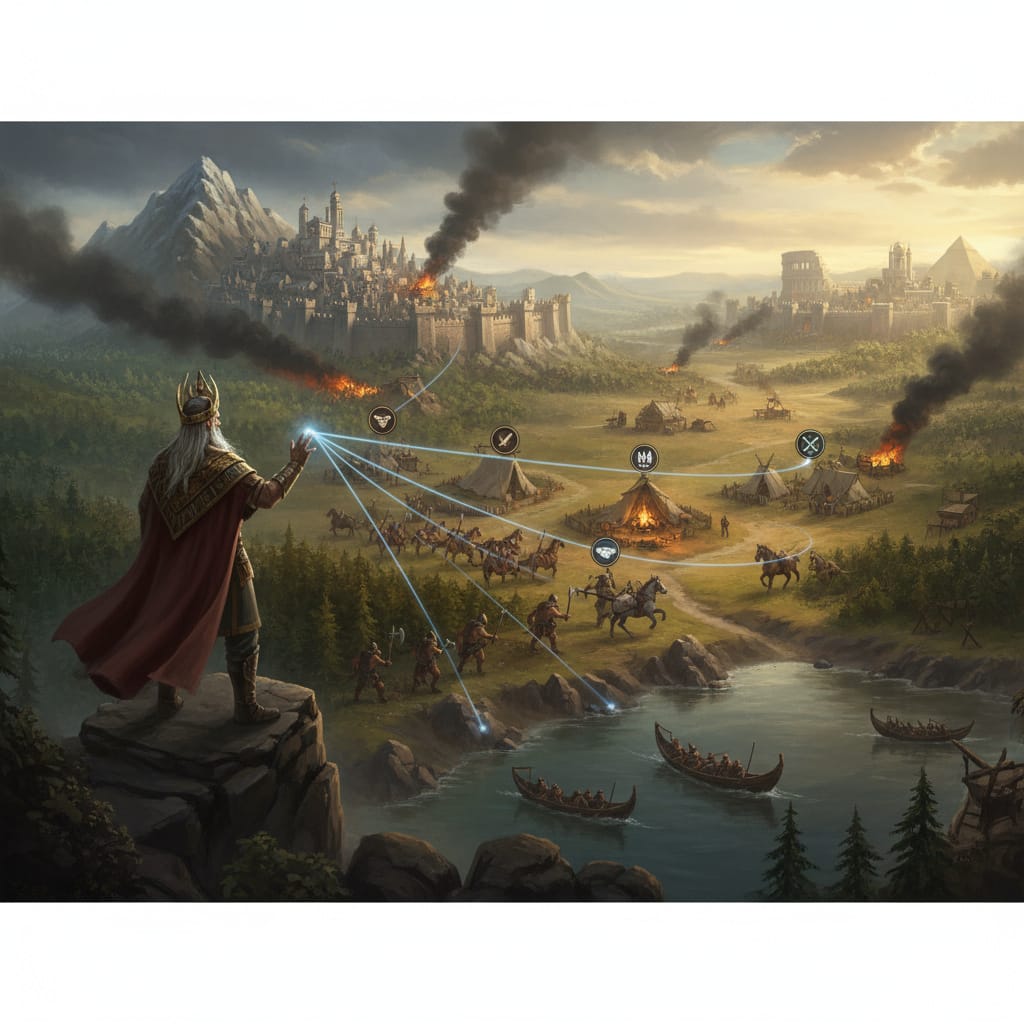
The familiar rhythm of Civilization 6 often begins with a predictable foe: the barbarians. They are the early game’s punching bag, a nuisance to be cleared for the sake of expansion and city development. But what if they were more? What if you could manipulate them, not just as a mindless obstacle, but as a strategic tool? The Barbarian Clans game mode transforms this familiar dynamic into a complex web of opportunities, where a well-played “rebel” strategy can lead to unconventional and decisive victories. This guide will delve into the nuanced strategies that have emerged from the player community, offering a comprehensive look at how to master the art of barbarian diplomacy and warfare.
The New World Order: Understanding Barbarian Clans
In this mode, barbarian outposts are no longer anonymous spawners of chaos. Each outpost belongs to a specific clan, complete with its own name and a progress bar toward becoming a city-state. There are seven distinct clan types, each with a predisposition towards certain units and terrain. Understanding these clans is the first step towards manipulating them effectively.
- Melee Tribes: These clans, found in woodlands, hills, and flatlands, focus on a mix of ranged, melee, and anti-cavalry units. They are the bread and butter of early-game barbarian encounters.
- Cavalry Tribes: Found in open plains, deserts, and jungles, these clans specialize in mounted units. They can be a significant threat to undefended cities and units.
- Naval Tribes: These seafaring clans will harass your coastal cities and trade routes. They can be a formidable early-game naval presence.
A crucial aspect of this mode is the accelerated tech-scaling of barbarian clans. Analysis on forums shows that if any civilization in the game researches a technology, barbarian clans have a chance to start producing units from that tech. This means you can face surprisingly advanced units from “primitive” barbarians, a factor that must be central to your strategic thinking.
The Art of the Deal: Interacting with Barbarian Clans
The Barbarian Clans mode introduces a suite of new interactions that move beyond the simple “disperse” option. Each interaction has a distinct impact on the clan and your relationship with them, and mastering these is key to a successful rebel strategy.
To Disperse or Not to Disperse?
The traditional approach to barbarian outposts is to destroy them for a quick boost of experience and to secure your borders. While this is still a viable option, especially for clans dangerously close to your capital, it’s often not the most strategic choice in this mode. Dispersing a clan eliminates a potential future city-state, a valuable asset in the mid to late game. Many professional gamers suggest a more nuanced approach, weighing the immediate benefit of a clear border against the long-term potential of a new city-state ally.
The Profitable Raid
Raiding a barbarian outpost offers a quick injection of gold without destroying the clan. This action, however, is not without consequences. The clan will spawn a defensive unit and become immune to further raids for a period. More importantly, raiding decreases the clan’s progress toward becoming a city-state. A popular strategy is to use raiding as a way to “farm” gold from a clan that you don’t want to see convert into a city-state, perhaps because it’s in a location you wish to settle yourself.

The Diplomatic Bribe
Bribing a clan prevents their units from attacking your cities for a set number of turns. This is a powerful tool for managing early-game aggression, especially if you’re focused on economic development. According to the player community, bribing is also a key tool for accelerating a clan’s conversion to a city-state. This is a crucial element of the “rebel” strategy: cultivating new city-states in strategic locations.
The Mercenary’s Hire
Hiring units from a barbarian clan is one of the most powerful and strategically interesting options in this mode. For a sum of gold, you can instantly raise a unit, often at a significant discount compared to producing it yourself. This can include unique units from civilizations not even in the game, giving you a unique military advantage. Analysis on forums shows that this is a popular strategy for early-game rushes, allowing you to field a powerful army long before your opponents. Like bribing, hiring also increases a clan’s progress toward city-state conversion.
The Art of Incitement
Inciting a barbarian clan to attack another civilization is a powerful and direct way to disrupt your rivals. For a fee, you can turn the barbarian tide against a chosen enemy, forcing them to divert resources to defense while you continue to develop your own empire. This action, however, decreases the clan’s progress toward city-state conversion. Many professional gamers suggest using incitement to soften up a target before a declaration of war, or to simply harass a rival who is pulling ahead.
The Ransom’s Price
If a barbarian clan captures one of your civilian units, you have the option to ransom them back. This is a simple and direct way to retrieve a valuable unit, but it comes at a cost: it decreases the clan’s progress toward city-state conversion. A popular strategy is to avoid this situation altogether by escorting your settlers and builders with military units, a fundamental tactic in the Barbarian Clans mode.
The Puppet Master: Advanced Barbarian Strategies
With a firm grasp of the new interaction options, you can begin to weave them into a cohesive and powerful strategy. The “rebel” approach is not about playing as a barbarian, but about becoming their puppet master, pulling the strings to achieve your own objectives.
Cultivating a City-State Empire
One of the most powerful long-term strategies in this mode is to actively cultivate the creation of new city-states. By strategically bribing and hiring from clans in locations that are advantageous to you, you can create a network of allied city-states that provide valuable bonuses, resources, and a buffer against your enemies. A popular strategy is to identify clans in remote locations, far from your own intended settlement areas, and nurture them into city-states. This can be particularly effective for a diplomatic victory, as more city-states mean more opportunities for envoys and diplomatic favor.

The Barbarian Leash: Harassing Your Rivals
The player community has extensively discussed the strategy of using barbarian clans as a weapon against your rivals. By leaving clans near your opponents’ borders and using the “incite” option, you can create a constant state of chaos for them. The AI, in particular, often struggles to deal with persistent barbarian threats, giving you a significant advantage. Analysis on forums shows that this can be a highly effective way to slow down a rival’s expansion and economic development, allowing you to pull ahead.
The Mercenary King: Building an Unconventional Army
The ability to hire units from barbarian clans opens up a world of military possibilities. You can build a powerful and diverse army without having to invest heavily in military infrastructure or research. A popular strategy is to use this to your advantage in the early game, launching a surprise rush with a horde of hired barbarians. This can be particularly effective if you can hire a unique unit that your opponent has no counter for. According to the player community, this is a high-risk, high-reward strategy that can lead to a swift and decisive victory if executed correctly.
The Barbarian Shield: A Defensive Strategy
While often used for offensive purposes, barbarian clans can also be a powerful defensive tool. By bribing clans near your borders, you can create a “barbarian shield” that protects you from early-game aggression. This allows you to focus on economic development and infrastructure, safe in the knowledge that your borders are secure. Many professional gamers suggest this as a viable strategy for civilizations that are not geared towards early-game military conquest.
Civilization Synergies: Who Benefits Most?
Certain civilizations have unique abilities that synergize particularly well with the Barbarian Clans mode. Understanding these synergies can give you a significant edge.
- Gold-focused Civilizations: Civilizations like Mali and Portugal, with their powerful gold-generating abilities, can easily afford to bribe, hire, and incite barbarian clans. This gives them a significant advantage in manipulating the new game mechanics.
- City-State Focused Civilizations: Civilizations like Greece and Hungary, which receive bonuses from city-states, benefit greatly from the ability to create new ones. A popular strategy for these civilizations is to actively cultivate as many new city-states as possible.
- Military-focused Civilizations: Civilizations with strong early-game military units, like the Aztecs and the Zulus, can use the “hire” option to further bolster their already powerful armies. This can lead to devastating early-game conquests.
A New Era of Barbarian Relations
The Barbarian Clans mode is more than just a minor tweak to the game; it’s a fundamental shift in the strategic landscape of Civilization 6. By moving beyond the simple “disperse” option and embracing the new interaction mechanics, you can transform the barbarians from a mere nuisance into a powerful tool for diplomacy, warfare, and economic disruption. The “rebel” strategy is not about chaos, but about control. It’s about understanding the new rules of the game and using them to your advantage. Analysis on forums shows that the most successful players in this mode are not those who simply fight the barbarians, but those who learn to dance with them, leading them in a carefully choreographed performance that ends with their own triumph. The next time you see a barbarian outpost, don’t just see a threat; see an opportunity.