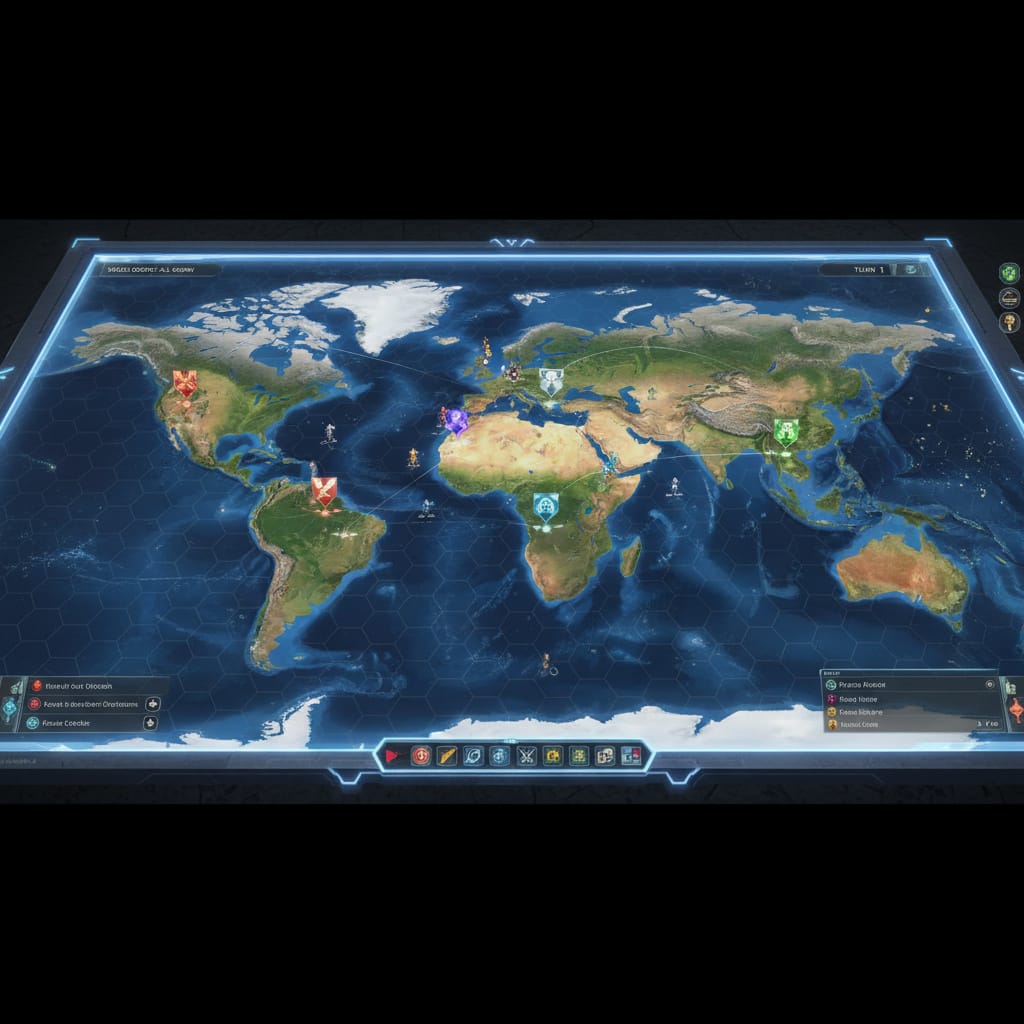
Imagine loading into a game of Civilization VI, and instead of a small circle of light in a vast sea of black, the entire world is laid bare. Every continent, every ocean, every mountain range, and, most importantly, every rival civilization’s starting location is known to you from the very first turn. The traditional age of discovery is over before it begins. This scenario, achievable through mods or debug tools, doesn’t just alter the game; it fundamentally rewrites its strategic DNA. The core pillar of exploration is removed, transforming the experience from a journey of discovery into a cutthroat game of perfect information. Analysis on forums shows that this shift creates a new, intensely strategic meta-game, where long-term planning and optimization take absolute precedence over adaptation and scouting.
The Death of Exploration, The Birth of the Master Plan
The most immediate and profound change is the complete nullification of the exploration phase. In a standard game, the first 50 turns are a frantic scramble to uncover the surrounding landscape, find city-states, locate natural wonders, and make first contact with other civilizations. Player communities often emphasize that this early-game scouting is a skill in itself, rewarding those who can efficiently balance exploration with initial development.
With a revealed map, this entire strategic layer vanishes. There is no need to produce multiple scouts. The tribal villages (goody huts) are all visible, allowing you to chart the most efficient path to claim them. The element of surprise is gone, replaced by a chessboard where all the pieces are visible from the start. This transforms the game into a test of pure strategic planning. According to the player community, this allows for the formulation of a grand strategy from turn one, a level of foresight normally impossible.
Key Changes to the Early Game:
- No Need for Scouts: Your first production choices are immediately altered. Instead of a scout, you can build a warrior for early defense or a settler to immediately claim a prime location.
- Optimized Pathfinding: You can send your initial warrior on a predetermined path to collect as many tribal villages as possible before returning to defend your burgeoning empire.
- Era Score Certainty: You know the location of every natural wonder and can plan to discover them for a guaranteed boost to your Era Score, making it easier to secure a Golden Age.
Settling the Perfect Empire: A Science of City Placement
Perhaps the most significant advantage of a revealed map is the ability to plan your city placements with near-perfect precision. In a normal game, settling is often a reactive process. You settle your capital, explore your immediate surroundings, and then make the best choice for your second and third cities based on limited information.
With full map knowledge, you can identify the absolute best city locations on the entire map from turn one. Many professional gamers suggest that this allows for a level of optimization that can feel like solving a puzzle. You can see the perfect campus locations with multiple adjacent mountains, the ideal harbor locations with multiple sea resources, and the chokepoints that will be critical for defense.
Strategic Settlement Considerations:
- Resource Clusters: You can identify areas with a high concentration of luxury and strategic resources. This allows you to plan your expansion to secure a diverse portfolio of resources, which is crucial for amenities and late-game military production.
- Adjacency Bonuses: You can map out your entire empire’s district layout from the beginning. This means you can plan for industrial zones that will cover multiple cities with their workshops and factories, or cultural districts that will benefit from adjacent wonders. A popular strategy is to identify a cluster of mountains and plan for a high-adjacency Holy Site or Campus.
- Wonder Placement: You know the terrain requirements for every wonder in the game. You can identify the perfect spot for the Great Zimbabwe next to a cluster of bonus resources, or the ideal location for the Mausoleum at Halicarnassus on a coastal tile with a natural harbor.
- Defensive Chokepoints: You can see the natural chokepoints on the map, such as mountain passes or narrow isthmuses. Settling these locations early can create impenetrable defensive positions, securing your borders for the rest of the game.
A New Era of Diplomacy and Warfare
Knowing the location of every civilization from the start dramatically alters the diplomatic landscape. First-contact bonuses are immediate, and you can instantly see who your neighbors are, who is isolated, and who is likely to be an early-game threat. Analysis on forums shows that this leads to a more calculated and less random diplomatic game.

Warfare also becomes a more deliberate and strategic affair. You can identify potential invasion routes, plan for naval invasions from the other side of the world, and anticipate where your enemies are likely to expand. The element of surprise is diminished, but the potential for grand, multi-pronged strategic assaults is greatly increased.
Diplomatic and Military Implications:
- Targeted First Impressions: You can immediately send a delegation to the civilizations you want to befriend and begin building positive relationships from turn one. Conversely, you can identify early threats and prepare for a preemptive strike.
- City-State Race: The race to be the first to meet every city-state is over. You know where they all are, and you can plan your envoy investments to gain suzerainty of the most valuable city-states for your victory condition.
- Strategic Deniability: A popular strategy is to identify a resource-rich area far from your starting location and send a settler on a long journey to claim it. This “forward settling” is much more effective when you know the land is undefended and your rivals are on the other side of the world.
- Calculated Aggression: You can assess the military strength of your neighbors and plan your attacks with much greater precision. You know their capital’s location, the surrounding terrain, and the most likely avenues of approach.
Victory Conditions: A Recalibrated Race
A revealed map impacts each of the victory conditions in unique ways, forcing a re-evaluation of traditional strategies.
- Domination Victory: This is perhaps the most directly buffed victory type. You can identify the weakest civilizations, the most strategic capitals, and the most efficient invasion paths from the very beginning. The entire game becomes a giant game of Risk, where you can plan your global conquest with perfect information.
- Science Victory: The race to space is also accelerated. You can identify the best campus locations for maximum science output and plan your city placements to optimize for production, which is crucial for late-game space projects.
- Culture Victory: A revealed map allows you to identify all potential sources of tourism from turn one. You can see where the natural wonders are, who your likely cultural rivals will be, and where to build your national parks for maximum appeal.
- Religious Victory: You can see the layout of the entire world, allowing you to plan the most efficient path for your missionaries and apostles to spread your religion. You can also identify the locations of other holy sites and prepare for theological combat.
- Diplomatic Victory: Knowing the locations of all city-states and civilizations from the start allows you to plan your diplomatic maneuvers with much greater precision. You can focus your efforts on the city-states that will give you the most diplomatic favor and anticipate the resolutions that will be proposed in the World Congress.
The Downside: Is Perfect Information Fun?
While the strategic advantages of a revealed map are undeniable, it’s important to consider the impact on the overall gameplay experience. For many players, the joy of Civilization comes from the sense of discovery and the challenge of adapting to an unknown world. A revealed map removes this element entirely.
The game becomes less of an adventure and more of a mathematical optimization problem. There are no surprises, no unexpected discoveries, and no need to adapt your strategy on the fly. While this can be a fascinating strategic puzzle for some, for others, it can feel sterile and predictable. The player community is divided on this point, with some enjoying the pure strategic challenge and others missing the thrill of the unknown.
A Strategic Sandbox
Playing Civilization VI with the entire map revealed from turn one is a fundamentally different experience. It transforms the game from a 4X epic of exploration and adaptation into a pure strategy game of perfect information. The strategic depth is immense, allowing for a level of long-term planning and optimization that is simply not possible in a standard game. While it may not be for everyone, it offers a fascinating glimpse into the strategic heart of Civilization, a world where every decision is a calculated move in a global game of chess. It’s a testament to the game’s robust design that it can be so radically altered and still offer such a compelling and challenging experience.