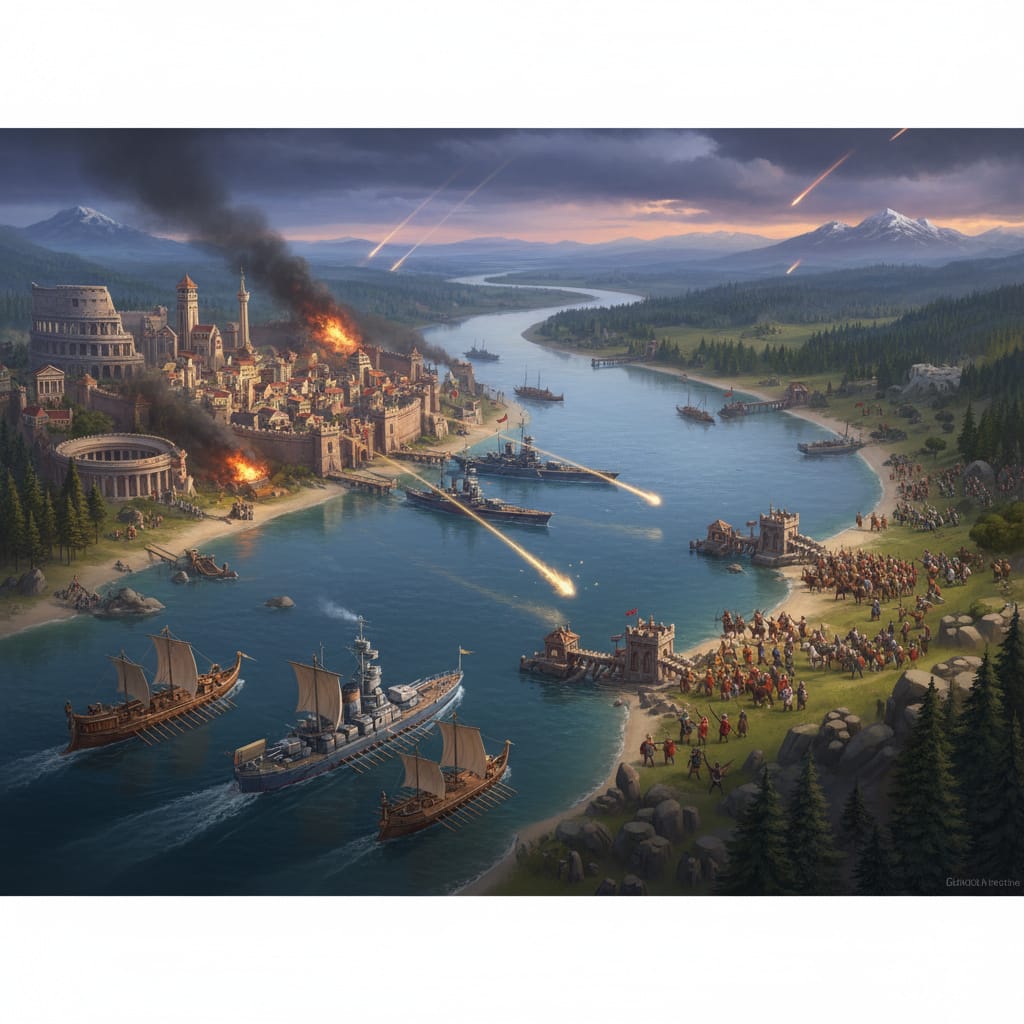
In the grand strategy of Civilization 6, rivers are the lifeblood of the early game. They provide fresh water, boost housing, and offer adjacency bonuses that shape the very foundation of our empires. But fundamentally, they are barriers—lines on a map that our mightiest fleets cannot cross. Player communities and strategy forums, however, often buzz with a fascinating hypothetical: What if this core rule was erased? What if rivers became navigable highways for every naval unit, from the ancient Galley to the modern Destroyer?
This is not a minor tweak; it is a paradigm shift. Such a change would fundamentally rewrite the strategic DNA of Civilization 6, transforming nearly every aspect of gameplay. The implications for warfare, economy, city placement, and civilization balance would be so profound that the game as we know it would become unrecognizable. This analysis delves into the strategic and tactical consequences of turning inland waterways into theaters of naval power, exploring how the familiar rhythm of building, expanding, and conquering would be irrevocably altered.
The New Rules of Engagement: Warfare on the Waterways
The most immediate and dramatic impact of navigable rivers would be on military strategy. The clear distinction between land and sea power would blur, creating a hybrid battlefield where naval dominance could decide the fate of even the most landlocked empires.
Early Game Aggression and the End of Safe Capitals
Analysis on forums shows that the early game would become brutally fast and aggressive. Currently, a capital city settled a few tiles inland is completely safe from naval attack. With navigable rivers, this safety evaporates.
- The Galley Rush: A civilization with a coastal start and a river leading directly to a neighbor’s capital could execute a devastating Galley rush. A fleet of two or three Galleys, perhaps supported by a single land unit to deliver the final blow, could bypass terrain and strike directly at an opponent’s heart before they’ve had time to build walls or a significant army. Civilizations like Norway, whose Longships can perform coastal raids, would become terrifyingly effective at pillaging districts and improvements deep within enemy territory from the safety of a river.
- Force Projection: The concept of “force projection” would be redefined. A single river system connecting multiple civilizations would become the game’s most critical strategic feature. Controlling the mouth of that river would be tantamount to holding a naval blockade against every city upstream.
Sieges from the River: Bypassing the Front Lines
A popular strategy is to use terrain to create defensive chokepoints. Mountains, hills, and forests are used to funnel enemy armies into kill zones. Navigable rivers would render many of these defenses obsolete.
- The Inland Armada: Imagine a city like Rome, historically a land power, finding its capital under bombardment from a Caravel or Frigate that sailed up the Tiber. Cities previously considered impregnable due to their position behind mountain ranges would become vulnerable if a river offered a backdoor.
- Ranged Naval Superiority: Naval ranged units, from the Quadrireme to the Battleship, would become the ultimate siege weapons. A single Battleship parked on a river tile next to an inland city center could single-handedly bring its defenses to zero without ever being exposed to retaliation from most land units. This forces a complete re-evaluation of unit composition; players would be forced to build anti-naval units not just for coastal defense, but for inland defense as well.
Economic Revolution: Rivers as Superhighways
The economic landscape of the game would shift just as dramatically as the military one. Rivers would transform from passive bonus providers into active conduits of wealth and trade, fundamentally altering the calculus of city development.

Trade Route Transformation
According to the player community, the value and nature of trade routes would be completely reimagined.
- Lucrative but Vulnerable: Trade Routes would naturally follow rivers, creating long, high-yield routes connecting coastal cities to the deep inland. A single route could generate immense gold and science. However, these riverine trade routes would be exceptionally vulnerable to pillaging by enemy naval units. A player with a single Privateer could wreak havoc on an entire continent’s economy.
- The Harbor’s New Role: The Harbor district would become arguably the most important district in the game. Currently restricted to cities on the coast or a lake, the ability to build a Harbor in any city on a river would be a game-changer. This provides access to powerful buildings like the Shipyard and Seaport, and more importantly, it grants an extra trade route capacity to potentially every city in an empire. The classic “Commercial Hub + Harbor” adjacency combo would become a staple of every river city, leading to unprecedented economic growth.
City Placement Reimagined
The criteria for a “good” city location would be rewritten. While fresh water and resources would remain important, access to a major river system would become the prime directive.
- River Confluences as Power Centers: A city settled at the confluence of two major rivers would be the equivalent of today’s best coastal locations. It would be a nexus of trade, a military staging ground, and an economic powerhouse.
- Devaluation of Landlocked Starts: Conversely, a start location without a significant river running through it would be considered a severe disadvantage, akin to starting in the middle of a desert today. Such a civilization would be cut off from the primary arteries of trade and military mobility.
Redrawing the Map: Exploration and Early-Game Strategy
The very pace of the game would accelerate from the first turn. The ability to explore with naval units from day one would shrink the world and intensify early-game competition.
Unprecedented Mobility and Discovery
Many professional gamers suggest that the early game would be a race to map the world’s river systems.
- Accelerated Exploration: A Galley can move faster and see further over water than a Warrior can on land. Players could send Galleys up rivers to quickly uncover the map, meet other civilizations, discover city-states, and locate natural wonders. The information advantage gained would be immense.
- The End of the “Isolated Start”: The dream of a safe, isolated corner of the map to peacefully build your empire would be a relic of the past. It would be far more likely for players to make contact within the first 20 turns, leading to earlier diplomacy, and more often, earlier conflicts.
Civilization Power Rankings: The New Naval Order
This hypothetical change would cause a massive upheaval in the civilization tier lists. Civs designed for naval or coastal play would skyrocket in power, while traditionally strong land-based civs would struggle to adapt.
The Winners: Masters of the Rivers
- Norway (Harald Hardrada): Already a coastal raiding menace, Norway would become the undisputed king of the early game. The ability to use Longships to pillage farms and districts hundreds of miles inland would be devastatingly effective.
- England (Victoria/Eleanor): The Royal Navy Dockyard is already one of the best unique districts. Being able to build it in every river city would give England an insurmountable economic and military advantage from the mid-game onward. Their late-game naval power, projected deep into continents, would be unstoppable.
- Phoenicia (Dido): Phoenicia’s ability to move its capital is already powerful. The ability to move it along a river system to a more strategic inland location would offer unparalleled flexibility. Their Cothon unique harbor would further amplify their riverine dominance.
- The Ottomans (Suleiman): The Barbary Corsair’s coastal raiding ability would now apply to any city on a river. Combined with the powerful naval siege bonuses from Grand Vizier Ibrahim, the Ottomans would be a military powerhouse across all eras.
- Japan (Hojo Tokimune): While not a traditional naval power, Japan’s “Meiji Restoration” ability, which grants standard adjacency bonuses for districts next to each other, would become incredibly powerful. With Harbors being built next to City Centers in every river city, Japan could create hyper-dense, high-yield city cores across its entire empire.
The Losers: Stranded on the Banks
- Land-Based Military Civs (Scythia, Mongolia, Rome): The unique advantages of these civilizations—fast cavalry, powerful legions—are diminished when an enemy can bypass their armies entirely. Their land-based military might is less relevant when the decisive battles are fought on the water.
- Defensive, Terrain-Focused Civs (Inca): The Inca’s mountain fortresses and Terrace Farms are designed for a land-based defense. While still powerful, their defensive security is compromised when an enemy fleet can simply sail past their mountain borders and attack from a river.
Collateral Damage: Rebalancing Core Mechanics
This single change would have a ripple effect, forcing a complete re-evaluation of several other game mechanics that interact with rivers.

- Bridges and Dams: How would these function? A popular strategy is to build Dams for power and flood protection. Would a Dam block naval passage? If so, Engineers would gain a new, critical strategic role in building and destroying these “river gates.” If not, the visual of a Battleship sailing over a dam would be nonsensical. The most logical implementation would be for Dams and Bridges to act as naval chokepoints, making their placement a crucial strategic decision.
- The Role of Air Power: With powerful naval units entrenched in rivers deep inside a continent, Air Power would become an essential counter. Bombers and Jet Bombers would be the most effective tool for dislodging these riverine fleets, making the late-game strategic layer even more complex.
- Map Generation: The logic of map scripts like “Pangaea” or “Continents” would be fundamentally altered. A single, continent-spanning river system would become the most valuable and contested geographical feature in the game, the equivalent of the Strait of Gibraltar and the Panama Canal combined.
A New World of Strategy
Making rivers navigable would be more than a simple rule change; it would be a complete reimagining of Civilization 6’s strategic landscape. The game would shift from a primarily land-centric contest to a dynamic, hybrid struggle for control of inland waterways. Early-game aggression would intensify, economic strategies would revolve around the Harbor district, and the very definition of a “good” start would be rewritten. The power balance between civilizations would be upended, creating a new naval order where control of the rivers means control of the world. While a fascinating thought experiment, it underscores the brilliance of the existing design; by making rivers a barrier, the game creates the very strategic puzzles of terrain, logistics, and force projection that we spend hundreds of hours trying to master. To open them up would be to create an entirely new, more fluid, and arguably more brutal world of Civilization.