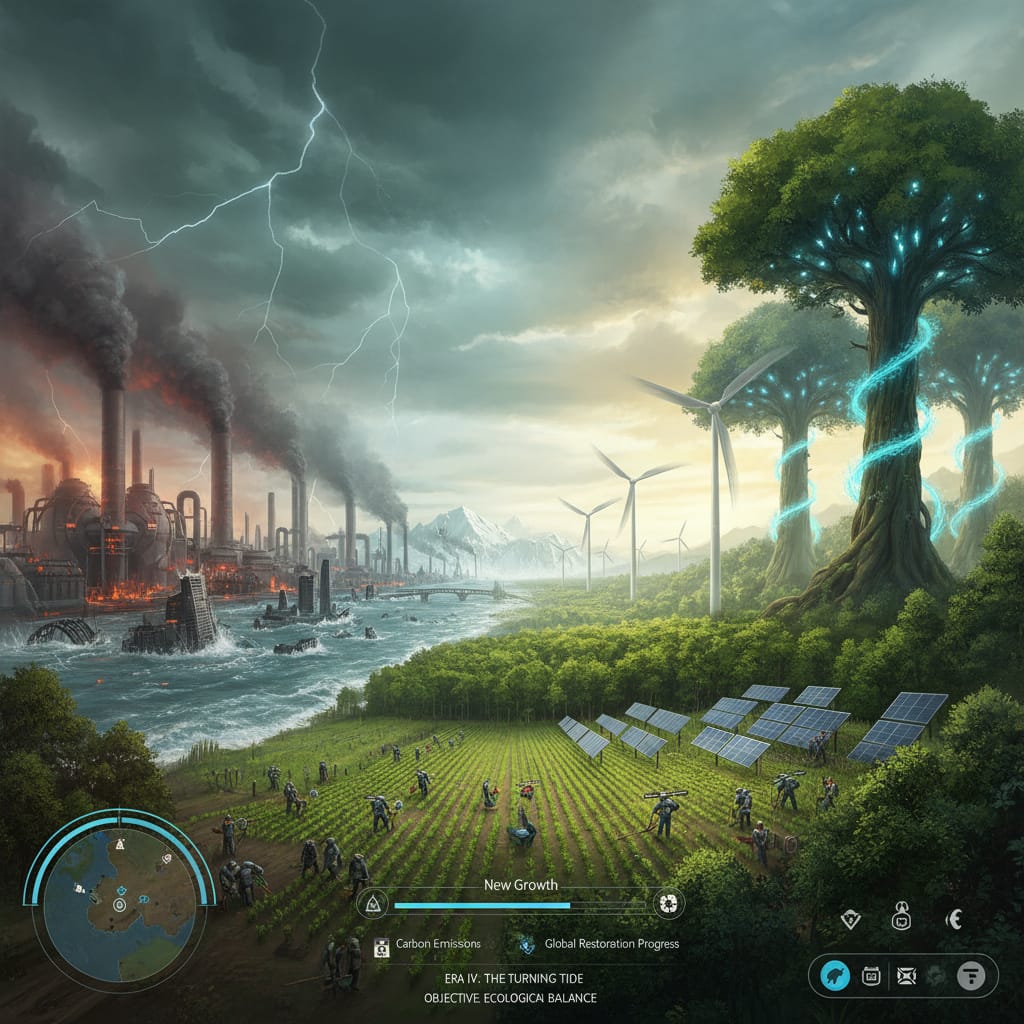
The “Gathering Storm” expansion for Civilization VI introduced a dynamic and perilous climate change system, forcing players to confront the consequences of their industrial ambitions. As CO2 levels rise, ice caps melt, and coastlines vanish beneath the waves. While the game provides tools to mitigate this crisis, such as renewable energy and carbon recapture projects, a significant real-world solution is notably absent from the strategic equation: large-scale afforestation. But what if it wasn’t? What if planting a simple forest could actively sequester CO2 and roll back the apocalyptic tide of climate change? This single change would fundamentally reshape every era of the game, introducing a new layer of strategic depth that would ripple through every victory condition.
The Current Climate Conundrum
In the current state of Civilization VI, climate change is a one-way street toward disaster, driven primarily by the consumption of Coal, Oil, and Uranium. Deforesting tiles for production provides a short-term gain but adds to the global CO2 count, accelerating the crisis. The primary tools for combating this are reactive. Players can build Flood Barriers to protect coastal cities, transition to green power, or, very late in the game, run the Carbon Recapture city project. Planting woods, a feature available since the base game, offers appeal and production bonuses but does nothing to combat the rising carbon levels. It’s a cosmetic touch in a world gasping for air. This forces a stark choice: industrialize and pollute, hoping to win before the world drowns, or deliberately stunt your growth to remain “green,” a path that is often strategically unviable on higher difficulties.
A New Era of Reforestation: The Proposed Mechanic
Analysis on forums shows a clear desire for a more proactive environmental toolkit. Let’s envision a new mechanic where planting woods, specifically “New Growth” (planted by builders), actively reduces CO2.
The Sequestration Formula
A popular strategy would be to tie the CO2 reduction to the age of the forest. Here’s how it could work:
- New Growth: When a builder plants a forest, it becomes “New Growth.” For the first 10 turns, it sequesters a small, flat amount of CO2 from the atmosphere, perhaps 1 CO2 per turn. This represents the initial, rapid growth phase of young trees.
- Mature Forest: After 10 turns, “New Growth” matures into a “Forest.” At this stage, its sequestration power becomes more significant. Many professional gamers suggest it could be tied to the tile’s appeal, representing a healthy, thriving ecosystem. For example, a Forest on a Breathtaking (4 Appeal) tile might sequester 4 CO2 per turn, while one on an Uninviting (-1 Appeal) tile might only sequester 1.
- Old-Growth Forest: After another 30-40 turns, a “Mature Forest” would become an “Old-Growth Forest.” These ancient woods would provide the highest sequestration rate, perhaps a base of 5 CO2 per turn, plus bonuses from appeal. They would also grant additional culture and faith, representing their majestic, inspiring nature.
This tiered system would reward long-term planning and create a powerful incentive to not only plant forests but to protect them.
Technological and Civic Integration
To prevent this from being a simple early-game exploit, the ability for forests to sequester CO2 could be unlocked through the tech and civic trees.

- Conservation Civic: The existing Conservation civic would be the perfect gate for this mechanic. Upon unlocking it, all newly planted forests would begin to sequester CO2. This aligns thematically with the civic’s focus on environmentalism and National Parks.
- Advanced Forestry (New Technology): A new Information or Future Era technology, “Advanced Forestry,” could allow for the creation of “Managed Forests.” These would be a special type of wood planted by builders that sequesters CO2 at a much higher rate, perhaps double the normal amount, but requires a strategic resource like Power to maintain, representing the energy needed for advanced cultivation and management.
Strategic Implications for Early-Game Development
Even with the Conservation civic gate, this change would reshape early-game priorities. The player community often debates the value of chopping versus preserving forests. This mechanic would add a powerful new variable to that calculation.
- The Long-Term Investment: Players would now have to weigh the immediate production boost from chopping a forest against the long-term benefit of its CO2 sequestration. A forest chopped in the Ancient Era is a forest that can’t help you in the Industrial Era when the climate crisis begins.
- Settlement Choices: Settling near large, open plains would become more attractive. These areas, previously just good for farms, would now be prime real estate for future reforestation projects. Civilizations with early access to builders, like Rome or the Aztecs, could gain a subtle but significant long-term environmental advantage.
- A New Role for Builders: Builders would become even more critical. Instead of just improving tiles for immediate yield, they would be the primary agents of your civilization’s climate strategy, tasked with planting the forests that will save the world.
Mid-Game Industrialization vs. Conservation
The Industrial and Modern eras are when the climate crisis truly kicks in. This is where the new reforestation mechanic would create the most interesting strategic dilemmas.
- The “Green” Gambit: A popular strategy would be to pursue a “Green” gambit. This would involve deliberately avoiding heavy industry and instead focusing on planting vast forests. This civilization would have lower production but would be single-handedly keeping the planet habitable. As other civilizations begin to suffer from rising sea levels, the “Green” civilization would be in a position of immense power.
- The Industrialist’s Hedge: For players who still want to pursue a high-production, fossil-fuel-powered strategy, reforestation would become a vital hedge. You could build your factories and power plants, but you would need to dedicate a significant portion of your land and builder charges to planting forests to offset your carbon footprint. This creates a fascinating balancing act between production and pollution.
- The “Carbon Sink” City: Players could specialize entire cities as “carbon sinks.” These cities, located in vast, open areas, would be dedicated to nothing but planting and preserving forests. They would generate little in the way of traditional yields but would be invaluable for their global contribution to climate stability.
Late-Game Climate Reversal and Diplomatic Clout
In the late game, the reforestation mechanic would transform international relations.
- The World Congress: New resolutions could be introduced in the World Congress related to reforestation. A civilization with a massive network of forests could propose a resolution that provides diplomatic favor for every 10 tiles of forest a civilization owns. They could also push for resolutions that punish civilizations with high pollution and low forest cover.
- Carbon Credits: A popular theory is that this could introduce a system of “carbon credits.” A civilization that is sequestering more CO2 than it produces could sell “carbon credits” to polluting civilizations. This would create a new global economy based on environmental stewardship. A warmongering civilization might find itself having to pay tribute to a peaceful, “green” neighbor to continue fueling its war machine.
- A New Form of Warfare: Environmental warfare would become a viable strategy. A player could declare war on a rival and specifically target their forests, chopping them down to accelerate climate change and cripple the rival’s economy. This would make protecting your forests as important as protecting your cities.
Civilization and Leader Synergies
This new mechanic would create powerful new synergies with existing civilizations and leaders.
- Brazil (Pedro II): With their bonus to Rainforest tiles, Brazil would become an environmental powerhouse. Their ability to gain adjacency bonuses from Rainforests would be supplemented by the CO2 sequestration of those same tiles.
- Canada (Wilfrid Laurier): Canada’s ability to build National Parks and their bonuses for tiles with high appeal would synergize perfectly with the appeal-based sequestration formula. A Canadian empire of vast, beautiful National Parks would also be a world leader in climate mitigation.
- Bull Moose Teddy (USA): Teddy’s appeal-based science and culture bonuses would make him a natural fit for a reforestation strategy. Planting forests would not only boost his yields but also help save the world, a perfect reflection of his historical conservationist legacy.
- Māori (Kupe): The Māori’s unique relationship with nature would be enhanced. Their ability to gain production and culture from unimproved woods and rainforests would now be combined with the inherent CO2 reduction of those features, making them the ultimate early-game environmentalists.
Impact on Victory Conditions
This change would have a profound impact on every victory condition.
- Science Victory: The race to space would become a race against the rising tides. A player focused on a science victory would need to carefully manage their carbon footprint or risk their coastal spaceports being flooded. Reforestation would be a critical part of any successful science game.
- Culture Victory: Culture players, who already focus on high appeal for National Parks and Seaside Resorts, would find that their existing strategy now also helps to save the world. A world with a stable climate is a world with more tourists, making a reforestation strategy a natural fit for a culture victory.
- Diplomatic Victory: As mentioned, a “green” civilization would have immense diplomatic clout. They could use their environmental leadership to gain diplomatic favor, win Nobel Prizes, and control the World Congress, making a Diplomatic Victory a very viable path for a reforestation-focused player.
- Domination Victory: A domination-focused player would have to factor the environmental cost of their conquests into their plans. A large, modern army consumes a massive amount of oil and uranium. This player would either have to conquer quickly or invest heavily in reforestation to avoid drowning their own empire.
A New Meta: Balancing Growth and Greenery
The introduction of a CO2 sequestration mechanic for forests would create a new, more complex, and ultimately more rewarding meta for Civilization VI. It would transform the simple act of planting a tree from a minor aesthetic choice into a powerful strategic tool. The game would no longer be a simple race to industrialize. It would become a delicate dance between growth and greenery, a constant balancing act between the needs of your civilization and the health of the planet. This single change would elevate the climate change system from a late-game nuisance to a core strategic element that would shape the entire game, from the first turn to the last. It would be a change that is not only thematically appropriate but would also make for a much deeper and more engaging gameplay experience.