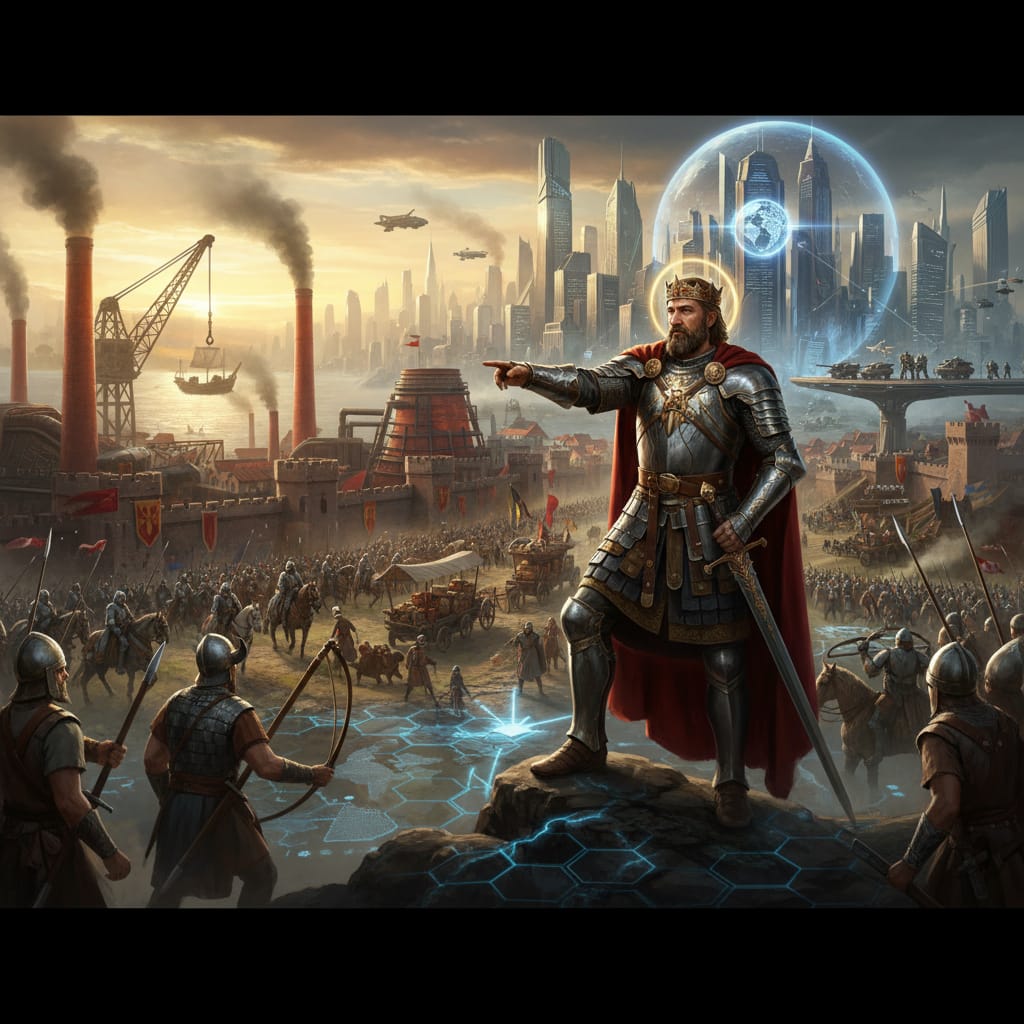
In the grand tapestry of Civilization 6, where every choice can echo through millennia, the selection of a leader is paramount. Each brings a unique flavor to their civilization, a distinct set of tools designed to carve a path to victory. Among these leaders, Frederick Barbarossa of Germany stands as a titan of industry and military might. His ability to build an extra district and the unparalleled production of the Hansa already make him a formidable force. But what if one of his key advantages, the extra military policy slot granted by his Holy Roman Emperor ability, was available from the very first turn? This is not a minor tweak; it is a fundamental shift in the strategic landscape of the early game, a change that would ripple through every era, transforming Germany from a strong contender into an undisputed powerhouse. Analysis on forums shows that this single change would unlock a cascade of strategic possibilities, allowing for an unprecedented level of flexibility and aggression from the dawn of civilization.
The Ancient Era: Forging an Unprecedented Early Advantage
The ancient era in Civilization 6 is a delicate dance of exploration, expansion, and survival. The threats are many, from barbarian hordes to the opportunistic aggression of neighboring civilizations. For most leaders, the early game is a series of calculated risks, a tightrope walk between building a military for defense and investing in the infrastructure for long-term growth. With an extra military policy slot from turn one, Barbarossa would not just walk this tightrope; he would sprint across it.
According to the player community, the standard opening for many civilizations involves a choice between policies like Agoge, for a boost to ancient and classical era melee and ranged unit production, and Discipline, for a combat strength bonus against barbarians. Barbarossa, however, would not have to choose. He could slot in both simultaneously. This seemingly small advantage is, in fact, monumental. It means that while other leaders are struggling to fend off barbarian incursions, Barbarossa is not only defending with greater efficiency but is also building his army at an accelerated rate. A popular strategy is to use this early military superiority to aggressively hunt barbarian encampments, reaping the rewards of era score and gold, and securing the safety of his burgeoning empire.
But the true game-changer lies in Barbarossa’s unique ability to attack city-states with a +7 combat strength bonus. With an extra military policy slot, this advantage becomes truly terrifying. Many professional gamers suggest that an early rush with a combination of warriors and slingers, empowered by both Agoge and Discipline, would allow Barbarossa to conquer a neighboring city-state before most other civilizations have even built their second city. This is not just about territorial expansion; it is about acquiring a fully functional city, complete with its own population and any districts it may have already built, without the need to produce a settler. This early conquest provides a massive boost to Germany’s population, science, and culture, catapulting them ahead of the competition.
Furthermore, the extra military slot provides unparalleled flexibility in responding to the early game’s unpredictable nature. Should a neighbor prove to be unexpectedly aggressive, Barbarossa can pivot to a defensive stance, slotting in policies that bolster his city defenses, without sacrificing the production bonuses that are so crucial for long-term success. This ability to adapt, to be both the aggressor and the defender without compromise, is a luxury that few other leaders can afford.
The Classical and Medieval Eras: The Hansa-Fueled Military Machine
As Germany transitions into the classical and medieval eras, the synergy between Barbarossa’s extra military policy slot and Germany’s unique industrial zone, the Hansa, comes to the forefront. The Hansa is already one of the most powerful unique districts in the game, capable of generating staggering amounts of production. With an extra military policy slot, Barbarossa can amplify this advantage to an almost absurd degree.

Analysis on forums shows that the Craftsmen economic policy card, which doubles the adjacency bonuses of industrial zones, is a cornerstone of Germany’s strategy. However, it is an economic policy, meaning that for most leaders, running it alongside military production policies requires a government with a balanced mix of policy slots. Barbarossa, with his extra military slot, faces no such constraints. He can run Craftsmen to boost his Hansas’ output while simultaneously using military policies like Feudal Contract (for a boost to medieval and renaissance era melee and ranged unit production) or Chivalry (for a boost to heavy and light cavalry production).
This creates a powerful feedback loop. The extra military policy slot allows for the simultaneous boosting of both production infrastructure and military unit production. The result is a military-industrial complex of unparalleled efficiency. While other civilizations are forced to choose between building up their cities and building up their armies, Germany can do both, and do them better.
A popular strategy is to use this period to build a professional army of crossbowmen and men-at-arms, units that benefit from the production bonuses of the Hansa and the policy cards that Barbarossa can so easily accommodate. This army can then be used to continue the aggressive expansion started in the ancient era, targeting not just city-states but rival civilizations as well. The ability to field a large, technologically advanced army, and to replenish losses at an astonishing rate, makes Germany a terrifying opponent in the mid-game.
Moreover, the extra military slot allows for a more nuanced approach to warfare. Policies like Logistics, which provides extra movement for all units, or Veterancy, which grants bonus experience to newly trained units, can be slotted in as needed, allowing Barbarossa to tailor his military to the specific challenges he faces. This level of strategic depth, this ability to fine-tune his military machine on the fly, is a direct result of the extra military policy slot.
The Renaissance and Industrial Eras: Forging a Global Empire
By the time the renaissance and industrial eras dawn, a Germany led by a Barbarossa with an extra military policy slot from the start would be in a position of overwhelming strength. The early game advantages, compounded over millennia, would have created a civilization with a powerful economy, a technologically advanced military, and a vast empire. Now, with the advent of even more powerful governments and policy cards, Barbarossa’s unique advantage would allow him to pursue global domination with ruthless efficiency.
Many professional gamers suggest that the choice of a tier 3 government is a pivotal moment in any game of Civilization 6. For a domination-focused Germany, the choice is clear: Fascism. This government provides a wealth of military policy slots, and when combined with Barbarossa’s unique ability, it creates a government with an unprecedented number of military policy options. This allows for the stacking of powerful late-game military policies, creating an army that is not just large and technologically advanced, but also imbued with a host of powerful bonuses.

Imagine a German army marching into battle under the influence of Logistics (for extra movement), Professional Army (for cheaper upgrades), Total War (for faster unit production and bonus experience), and Grand Armée (for a combat strength bonus). This is not a mere army; it is a blitzkrieg on a global scale, a military force capable of steamrolling even the most well-defended empires.
Furthermore, the extra military policy slot provides the flexibility to manage the logistical challenges of a global empire. Policies that reduce war weariness, or that provide amenities to newly conquered cities, can be slotted in as needed, ensuring that the German war machine can continue its relentless advance without being bogged down by internal strife.
And what of Germany’s other unique abilities? The U-Boat, a powerful late-game naval unit, becomes even more formidable when its production is boosted by the Hansa and the appropriate policy cards. The ability to build an extra district in each city, a powerful advantage in its own right, becomes even more so when the production from those districts is amplified by the economic policies that Barbarossa can so easily run alongside his military ones.
Beyond Domination: A Flexible Path to Any Victory
While the most obvious application of an extra military policy slot is for a domination victory, its true power lies in its flexibility. Analysis on forums shows that the extra slot can be used to support any victory condition, providing a level of security and adaptability that is unmatched by any other leader.
For a science victory, the extra military slot can be used to run defensive policies, ensuring that Germany’s campuses and spaceports are safe from enemy aggression. It can also be used to slot in policies that boost production towards space race projects, accelerating the path to the stars. A popular strategy is to maintain a strong, technologically advanced military, not for conquest, but as a deterrent, allowing the German people to focus on their scientific endeavors without fear of interruption.
For a culture victory, the extra military slot can be used to protect Germany’s cultural centers and wonders from plunder. It can also be used to boost the production of archaeologists and other cultural units, accelerating the acquisition of artifacts and the generation of tourism. The ability to maintain a strong defense without sacrificing the economic and cultural policies necessary for a culture victory is a powerful advantage.
Even for a religious victory, the extra military slot has its uses. A strong military can be used to protect Germany’s religious units as they spread the faith, and to conquer rival holy cities, crippling their religious ambitions. The ability to wage a holy war with both religious and military units, each empowered by their own set of policy cards, is a unique and powerful strategy.
The Verdict: A Game-Changing Advantage
The hypothetical scenario of Barbarossa having an extra military policy slot from the very beginning of the game is more than just a minor buff; it is a fundamental transformation of Germany’s strategic potential. It takes a civilization that is already strong and makes it a true titan, a force to be reckoned with from the dawn of time to the modern era. The ability to be both aggressive and defensive, to build both a powerful military and a thriving economy, to pursue any victory condition with a level of flexibility and security that is unmatched by any other leader, is a game-changing advantage. In the world of Civilization 6, where every decision matters, this single change would elevate Barbarossa from a king to an emperor, a true ruler of the world.