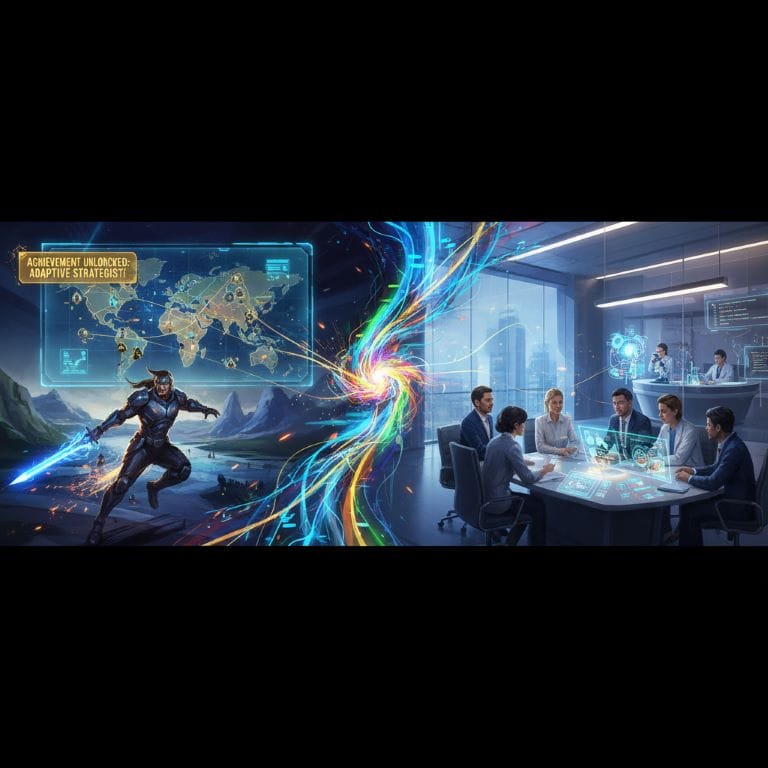
The persistent chime of an achievement unlocked, the hard-fought victory screen after a grueling match, the collective cheer of a guild downing a raid boss for the first time. For many, these are fleeting digital highs, confined to the glowing rectangle of a monitor. The common narrative paints gaming as an escape—a frivolous, time-consuming hobby disconnected from the “real world.” This narrative is fundamentally flawed. It misses the forest for the pixels.
Video games, particularly complex, competitive, and cooperative ones, are not just pastimes; they are sophisticated, interactive training simulators for the modern world’s most in-demand skills.1 Every victory you achieve is the result of a complex interplay of cognitive, emotional, and social abilities that are directly transferable to boardrooms, laboratories, and personal development. The problem isn’t that the skills don’t exist; it’s that most players have never been given the language or the framework to identify, articulate, and deliberately apply them.
This guide will provide that framework. We will deconstruct the anatomy of an in-game victory and map its components to tangible, real-world success. Forget vague platitudes about “improved hand-eye coordination.” We are diving deep into the psychology of strategy, the mechanics of resilience, and the art of digital collaboration. This is your playbook for turning countless hours of dedicated play into a quantifiable advantage in your career, your projects, and your life.
Deconstructing the Win: Beyond the High Score
Before we can translate skills, we must first understand what they are. A win in a game like StarCraft II, Elden Ring, or a high-stakes Valorant match is never just about fast reflexes. It’s the successful execution of a multi-layered process. Thinking about your victories through this lens is the first critical step. Ask yourself not that you won, but why you won. The answer almost always involves a combination of the following skill domains.
- Cognitive Mastery: Your ability to process information, plan, and adapt your strategy in real-time.2
- Emotional Fortitude: Your capacity to manage pressure, handle failure, and maintain focus over long periods.
- Social Dynamics: Your skill in communicating, coordinating, and leading or following within a team structure.
- System Optimization: Your drive to find efficiencies, improve processes, and make data-informed decisions.
Every skill we will explore falls into one of these core pillars. The key is to shift your perspective from seeing yourself as a “gamer” to seeing yourself as a “practitioner of complex problem-solving in a simulated environment.”
The Strategist’s Mindset: Mastering Systemic Thinking
At their core, most games are complex systems of rules, resources, and variables. Winning requires you to understand and manipulate these systems better than your opponents. This cultivates a powerful form of systemic thinking that is invaluable in any field that involves strategy, from business management to financial planning.
Pattern Recognition and Predictive Analysis
In-game, you are constantly absorbing and processing patterns. You learn the attack animations of a boss, the common choke points on a map, or the predictable build order of an opponent in a strategy game. This isn’t just memorization; it’s subconscious predictive analysis.
- Concrete Example (Gaming): In League of Legends, you notice the enemy jungler consistently ganks the top lane around the 3:15 mark after completing their first clear. You recognize this pattern, place a ward in anticipation, and communicate the threat to your teammate. You’ve just used predictive analysis based on pattern recognition to prevent a negative outcome.
- Actionable Translation (Real World): In a project management role, you notice that a specific team member consistently underestimates their task completion times by about 20%, particularly on coding tasks. Recognizing this pattern, you don’t call them out publicly. Instead, you build a 20% buffer into their deadlines during sprint planning or work with them to break tasks into smaller, more accurately estimated chunks. You are using the same predictive skill to mitigate risk and ensure project timelines are met.
Advanced Resource Management
Games are masterful teachers of scarcity and allocation. Whether it’s mana, minerals, ammunition, or a limited stamina bar, you are forced to make constant, high-stakes decisions about how to best use what you have to achieve your goals.
- Concrete Example (Gaming): In a city-builder like Cities: Skylines, your starting budget is tight. You must decide: do you invest in more power plants to support future growth (long-term investment), or do you build a new school to increase citizen happiness and tax revenue now (short-term gain)? An unwise allocation early on can lead to a “death spiral” of debt and citizen dissatisfaction later. You learn to balance immediate needs with future requirements.
- Actionable Translation (Real World): You’re given a $10,000 budget to launch a marketing campaign for a new product. Do you spend the bulk of it on a high-impact, short-term influencer collaboration, or do you allocate it across a slower, more sustainable content marketing and SEO strategy? Your gaming experience has trained you to weigh these trade-offs, considering concepts like return on investment (ROI), burn rate, and the opportunity cost of choosing one path over another. You can articulate this by explaining, “My approach is to allocate 60% to the long-term SEO foundation, which has a lower immediate impact but higher compounding value, and 40% to targeted ads for initial customer acquisition, mirroring a balanced resource strategy.”
Multi-Variable Risk Assessment
Every significant action in a game carries a risk and a potential reward. Deciding whether to engage an enemy, push for an objective, or use a powerful but long-cooldown ability is a rapid calculation of probabilities and outcomes.3
- Concrete Example (Gaming): In the battle royale Apex Legends, your squad has a positional advantage but is low on shields. Another squad approaches. Do you engage them, hoping your superior position outweighs your resource disadvantage for a chance at their loot? Or do you disengage, forfeiting the position to find more resources but guaranteeing your survival for the moment? There is no single “right” answer. The decision depends on numerous variables: your team composition, the closing ring’s location, the number of squads left, and your confidence in your aim.
- Actionable Translation (Real World): A startup founder is deciding whether to pivot their business model. The current model is generating modest, stable revenue. The proposed pivot targets a much larger market but has no guarantee of success and would require significant capital investment, risking the entire company. This is a high-stakes risk assessment. A gamer’s mind is naturally attuned to this. You can break down the problem by identifying the variables (market size, R&D cost, potential ROI, competitor landscape), assigning probabilities to different outcomes, and creating contingency plans—just like planning a complex raid encounter.
Forged in Digital Fire: Cultivating Unbreakable Resilience
Modern games are designed to be challenging. They push you to the brink of failure and demand you get back up, learn, and try again.4 This relentless cycle is an incredibly effective, if sometimes frustrating, training ground for emotional resilience and mental fortitude.
Embracing Failure as Actionable Data
In the real world, failure can be emotionally devastating and carry significant consequences. In a game, failure—a death, a lost match, a wiped raid—is a low-stakes learning opportunity. This reframes your entire relationship with mistakes.
- Concrete Example (Gaming): You are trying to defeat a notoriously difficult boss in Sekiro: Shadows Die Twice. Your first ten attempts end in swift defeat. Instead of getting angry, you start to analyze. “Okay, attempt #11, I learned he follows his thrust attack with a sweep. I need to jump, not dodge.” “Attempt #12, I see the tell for his grapple attack is a specific glint.” Each failure provides a new piece of data that you incorporate into your next attempt, until you finally succeed. The loss is not an endpoint; it’s a vital part of the process.
- Actionable Translation (Real World): You deliver a presentation to a client, and they don’t buy your product. The “failure” stings. A non-gamer might internalize this as “I’m bad at sales.” A gamer’s mindset sees it as data. You conduct a post-mortem: Which part of the presentation did their engagement drop off? What questions did they ask that I couldn’t answer smoothly? Was my value proposition unclear? You treat the failed pitch like a failed boss attempt, analyzing the tape to refine your strategy for the next one. This shift from emotional reaction to analytical response is a superpower.
Maintaining Composure Under Extreme Pressure
Clutch moments. That heart-pounding, 1-vs-4 situation where the entire game rests on your shoulders. The final 10% of a raid boss’s health where one mistake means a wipe. These scenarios are intense pressure cookers that train your ability to filter out noise, focus on the critical task at hand, and execute with precision.

- Concrete Example (Gaming): You are the last one alive in a round of Rainbow Six Siege. The timer is ticking down, you know the enemy’s approximate location, and your teammates are watching your every move. Panic leads to mistakes. Instead, you control your breathing, focus on sound cues, methodically clear corners, and execute your plan. You are practicing emotional regulation in a high-stakes environment.
- Actionable Translation (Real World): You’re in a critical job interview, and the hiring manager asks you a tough, unexpected technical question. The pressure is on. Your gaming experience in clutch moments helps. Instead of panicking, you take a breath, acknowledge the question’s difficulty (“That’s an excellent question, let me think that through for a moment.”), and break the problem down logically. You manage the adrenaline spike and deliver a composed, thoughtful answer, even if it’s not perfect. This composure is often more impressive to employers than simply knowing the answer immediately.
The Power of “The Grind” and Delayed Gratification
Many games incorporate long-term progression systems that require consistent effort for rewards that may be weeks or months away. This is often called “the grind.” While it can seem tedious, it’s a powerful lesson in the value of sustained effort and delayed gratification.
- Concrete Example (Gaming): Leveling a character to the maximum level in an MMORPG like World of Warcraft or Final Fantasy XIV. It involves completing thousands of quests and requires a long-term commitment. There is no instant reward. You do it because you have a long-term goal: to participate in endgame content.
- Actionable Translation (Real World): Learning a new, complex skill like coding, playing a musical instrument, or becoming fluent in a new language. The initial stages are often slow and unrewarding. It’s a grind. Your experience in gaming has conditioned you to understand that consistent, daily effort—even when it feels unproductive—compounds over time to produce mastery. You are less likely to quit during the frustrating “trough of sorrow” because you have internalized the link between persistent effort and eventual, significant reward.
The Guild Leader’s Playbook: Honing Elite Social Dynamics
Multiplayer games are microcosms of society and the modern workplace. Coordinating a group of diverse individuals, often with different personalities, skill levels, and time zones, towards a common goal is a masterclass in communication, leadership, and teamwork.
Crystal-Clear, Concision-Driven Communication
When a dragon is breathing fire on your team, there’s no time for corporate jargon or vague instructions. Communication must be clear, concise, and actionable. This teaches an incredibly efficient form of communication that is highly prized in fast-paced work environments.
- Concrete Example (Gaming): During a raid, a leader doesn’t say, “We should probably think about mitigating the upcoming area-of-effect ability.” They say, “Stack on me in 5! Healer 2, use your barrier! Ranged DPS, focus the south add NOW!” The instructions are direct, assign responsibility, and are time-sensitive.
- Actionable Translation (Real World): Leading a team meeting. Instead of ending with a vague, “Let’s all try to move this project forward,” you apply the raid leader’s clarity. “Okay, to summarize our action items: Sarah, you will have the draft report to me by Wednesday at 5 PM. Mike, you will coordinate with the design team and provide them the final specs by Thursday morning. I will follow up with the client to confirm the deadline. Are there any questions on these assignments?” It removes ambiguity and ensures accountability.
Role Specialization and Interdependent Trust
The classic “holy trinity” of Tank, Healer, and DPS in many RPGs is a perfect model for specialized teams. The Tank doesn’t try to do the Healer’s job, and the Healer trusts the Tank to hold the enemy’s attention. Success is impossible unless every member executes their specific role and trusts their teammates to do the same.
- Concrete Example (Gaming): In an Overwatch team, the Reinhardt player’s job is to create space and protect the team with his shield. He must trust that his Ana will heal him from the backline and his Cassidy will deal damage to the enemies he is creating space from. If that trust breaks down—if Reinhardt charges in alone or Ana tries to be a frontline DPS—the entire team structure collapses.
- Actionable Translation (Real World): This is the very essence of a high-functioning project team. The backend developer must trust that the UI/UX designer has created a functional and intuitive interface, who in turn trusts that the project manager has accurately gathered the client’s requirements. Your experience in a guild or team has taught you how to rely on others’ expertise, how to define your own contribution clearly, and how to understand that your individual success is inextricably linked to the group’s success.
Giving and Receiving Constructive Feedback
Wiping on a boss is a moment ripe for finger-pointing and blame. Effective gaming teams, however, turn it into a constructive debrief. They analyze what went wrong in a depersonalized, goal-oriented way.
- Concrete Example (Gaming): After a failed attempt, the raid leader says, “Okay, on that last pull, the positioning was off. The ranged group was too close to the melee, which caused the cleave attack to hit everyone. On the next pull, let’s make sure there’s a 15-meter gap. Also, Dave, you were a bit late interrupting the ‘Doom’ cast. Let’s make that your number one priority.” The feedback is specific, behavioral, and focused on the next attempt’s success, not personal failure.
- Actionable Translation (Real World): During a peer review or project post-mortem, this skill is critical. Instead of saying, “Your report was confusing,” you can offer feedback in a game-tested, constructive way: “I found the data in section two very compelling, but I had trouble connecting it to the main conclusion in the summary. Perhaps adding a sentence to bridge that gap would strengthen the overall argument.” It’s specific, helpful, and respects the other person’s effort while still driving improvement.
From Pixels to Paychecks: A Practical Framework for Translation
Identifying these skills is the first half of the battle. The second, more crucial half is articulating them in a way that hiring managers, colleagues, and collaborators will understand and value. You must learn to reframe your experience.
Step 1: Audit and Inventory Your Skills
Take your primary game or games and perform a skill audit. Don’t just list the game; list the actions you perform and the skills they represent. Create a document for yourself.
- Game:EVE Online
- Activity: Running a corporation (a player-run organization).
- Skills: Economic planning, supply chain management, long-term strategic forecasting, personnel management, conflict resolution, market analysis (buying low, selling high).
- Game:Valorant (High Rank)
- Activity: In-game shot-calling for a team.
- Skills: Real-time tactical decision-making, clear and concise communication under pressure, team motivation, opponent analysis, and counter-stratification.
- Game:Factorio / Satisfactory
- Activity: Designing and optimizing a massive, automated factory.
- Skills: Systems thinking, logistics, process optimization, identifying and eliminating bottlenecks, project planning and execution at scale.
Step 2: Translate Gaming Jargon into Professional Language
No one will be impressed if you put “Cleared Mythic Fyrakk” on your resume. You need to translate the accomplishment into the underlying skills it represents.
- BEFORE: “Led a 20-person raid guild in World of Warcraft.”
- AFTER: “Directed a 20-person international team in a high-pressure, results-oriented environment. Responsible for strategic planning, resource allocation, and real-time tactical adjustments to overcome complex challenges, resulting in a 30% improvement in team performance metrics over a six-month period.”
- BEFORE: “Achieved a high rank in StarCraft II.”
- AFTER: “Utilized advanced data analysis and predictive modeling to anticipate opponent strategies and optimize resource allocation in a competitive setting, consistently performing in the top 1% of a global player base.”
Step 3: Showcase, Don’t Just Tell
Whenever possible, create tangible proof of your abilities. Your gaming hobby can become a portfolio of real-world skills.5
- Community Management: If you run a successful Discord server for your guild or community, that is demonstrable experience in community management, moderation, and event planning.
- Content Creation: Do you write guides for your game? That showcases your analytical skills, writing ability, and expertise. Do you create YouTube videos or stream on Twitch? That demonstrates communication skills, technical proficiency, and the ability to build an audience.
- Project Management: Organizing a large-scale in-game event, a tournament, or a complex multi-group raid is a project. Document the process: the planning phase, the recruitment, the execution, the post-event analysis. You have just created a project management case study.
Step 4: Target Skill-Aligned Careers
Recognize which professions inherently value the skills you’ve been honing for years.
- Systems Thinkers (Factorio, Civilization): Look at careers in logistics, supply chain management, urban planning, systems analysis, and software architecture.
- Strategists & Leaders (League of Legends, EVE Online): Consider project management, business strategy, military or intelligence analysis, and management consulting.
- Resilient Optimizers (Dark Souls, Speedrunners): You would excel in Quality Assurance (QA) testing, research and development (R&D), data analysis, and any field that requires intense iteration and a high tolerance for failure.
- Social Coordinators (World of Warcraft, Final Fantasy XIV): You are a natural fit for roles in community management, HR, event planning, and any position that requires coordinating large teams of people.
The Final Boss is Your Own Mindset
The greatest barrier to translating your in-game victories into real-world success is the lingering belief that it’s “just a game.” It’s not. It is a voluntary, high-engagement training ground for some of the most difficult-to-teach skills in the modern economy: adaptive problem-solving, emotional resilience, and complex system navigation.
The hours you’ve invested are not lost. They are a deep well of experience. You have led teams, managed complex economies, and snatched victory from the jaws of defeat under immense pressure. You have failed thousands of times and learned from every single mistake. Now, it is time to stop seeing your hobby as a liability on your resume and start framing it for what it truly is: your competitive advantage. Take the language, the framework, and the examples from this guide. Analyze your own victories, articulate your skills with confidence, and apply them with intention. The game is over. It’s time to go claim your loot.