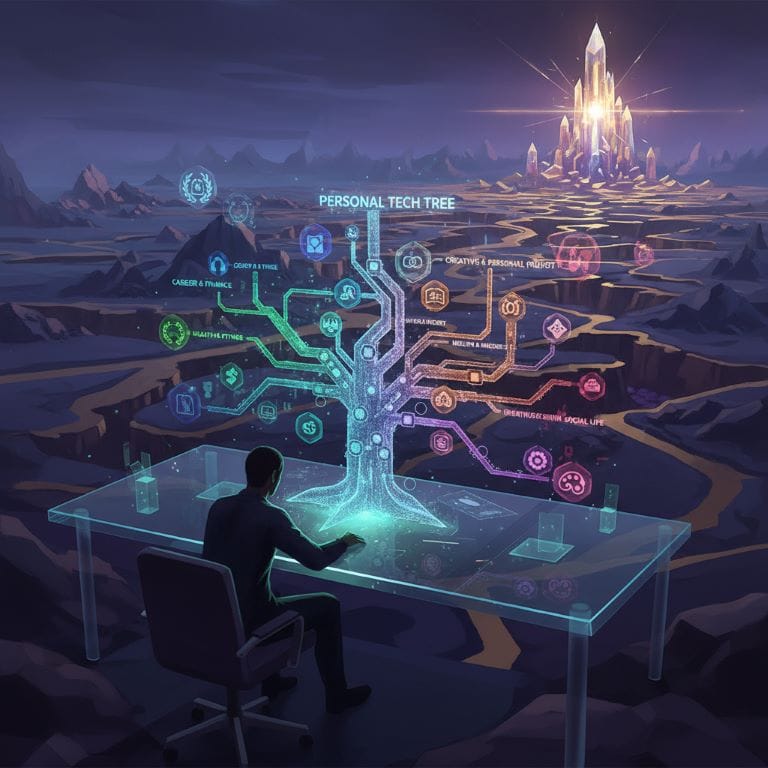
The greatest strategy game isn’t played on a screen. It’s the intricate, ever-evolving game of your own life. You are the player, and your “character” has stats, abilities, and a vast, unexplored map of potential. In the games you love, victory is never accidental. It’s the result of a meticulously planned strategy, a deep understanding of the game mechanics, and a relentlessly optimized build order. You wouldn’t dare attempt to conquer a 4X galaxy or defeat a raid boss without a plan for progression. Why should your own life be any different?
This is where the concept of a Personal Tech Tree comes in. It’s not just another to-do list or a set of vague resolutions. It’s a strategic framework borrowed directly from the games you’ve mastered. It’s a visual, interconnected map of the skills, knowledge, and habits you need to acquire to achieve your ultimate “win condition.” It transforms the abstract idea of “self-improvement” into a concrete, actionable, and deeply satisfying game.
This guide will walk you through the entire process of designing, building, and executing your own personal tech tree. We’ll move beyond generic advice and dive deep into the strategic mindset required to turn your ambitions into achievements. Get ready to spec your character for victory.
Phase 1: Defining Your “Win Condition” – The End-Game Vision
Before you can even think about the first skill point, you need to know what game you’re trying to win. In a strategy game, this is your victory condition—be it conquest, technology, or culture. In the game of your life, this is your long-term vision. A vague goal like “be successful” is a losing strategy. It’s the equivalent of starting a game of Civilization with no idea whether you’re going for a science victory or domination. You need a clear, high-resolution picture of your end-game.
The 5-Year Legendary Quest
Forget fuzzy, distant dreams. Let’s frame this as your “5-Year Legendary Quest.” Where do you want your character to be in five years? This timeframe is the strategic sweet spot: long enough for significant, transformative change, but short enough to remain tangible and motivating.
To define this, you need to script the victory cinematic. Grab a document or a notebook and write, in detail, the answers to these prompts:

- Career & Finance: What is your professional title? What specific, impactful work are you doing? What does your income look like, and what level of financial freedom have you achieved? Don’t just say “a better job.” Say, “I am a Senior Game Designer at a leading indie studio, responsible for core gameplay mechanics, earning $150,000 annually.”
- Health & Fitness: What is your physical state? How do you feel when you wake up? What physical feats are you capable of? Instead of “be healthier,” specify “I have 15% body fat, can run 10km in under 50 minutes, and have the energy to work a full day and still enjoy my evenings.”
- Knowledge & Mindset: What do you know? What complex topics can you discuss with authority? How have you fortified your mind against stress and negativity? Think, “I am fluent in Spanish, can read and understand philosophical texts by the Stoics, and have a consistent meditation practice that keeps me grounded.”
- Relationships & Social Life: What does your social circle look like? What is the quality of your key relationships? How do you contribute to your community? Be specific: “I have a core group of five close friends with whom I have deep, supportive relationships, and I actively mentor one junior professional in my field.”
- Creative & Personal Pursuits: What are you creating? What hobbies have you mastered? What brings you joy and fulfillment outside of work? For example, “I have written and self-published a 70,000-word sci-fi novel and can play three of my favorite songs on the guitar from memory.”
This detailed vision isn’t a fantasy; it’s your target. It’s the final technology in your tech tree, the ultimate unlock that all other skills build toward. This “Legendary Quest” document is now your strategic north star.
Phase 2: Scouting the Map – Auditing Your Current Skill Stack
No general attacks without first scouting the terrain. Before you can plot a path to your win condition, you need to know your exact starting position. This means conducting a brutally honest audit of your current “skill stack” and resources. The fog of war must be lifted from your own capabilities.
This process is about creating your character sheet as it exists right now. Divide your audit into the same categories you used for your 5-Year Legendary Quest. For each category, list out your current skills, knowledge, and attributes. Assign a proficiency level to each—think in gaming terms: Novice, Adept, Expert, Master.
Example: Career Audit (Aspiring Game Designer)
- Current Title: Junior QA Tester
- Skills:
- Bug Reporting (Expert): I can write clear, concise, and actionable bug reports.
- Game Mechanics Analysis (Adept): I have a good feel for what makes a game fun but struggle to articulate the “why” in design terms.
- Unity Engine (Novice): I’ve completed the “Roll-a-ball” tutorial and understand the basic interface, but nothing more.
- C# Programming (Novice): I know what a variable and a
forloop are, but I can’t build a system from scratch. - Team Communication (Adept): I work well with my QA team but have limited interaction with the development or design teams.
- Project Management (Novice): I manage my own tickets but have no experience with broader project planning.
The “Assets and Debuffs” Assessment
Beyond skills, list your current Assets (resources you can leverage) and Debuffs (obstacles or weaknesses you need to manage).
- Assets:
- Time: I have 10-15 hours per week of free time for learning.
- Financial: I have $500 saved for courses or books.
- Network: I’m friends with a mid-level artist at my company.
- Traits: I’m a very persistent and detail-oriented person.
- Debuffs:
- Habits: I tend to procrastinate on starting new, difficult learning projects.
- Environment: My apartment is small and noisy, making focused work difficult.
- Mindset: I suffer from imposter syndrome when I compare myself to senior developers.
This audit gives you your starting coordinates. The gap between this “Current State” audit and your “5-Year Legendary Quest” is the map your tech tree needs to cover. You now know exactly how far you have to travel and what terrain you need to cross.
Phase 3: Designing the Core Branches – Your Main Questlines
With your start and end points defined, it’s time to draw the major highways. These are the main branches of your tech tree, representing the high-level “questlines” you must complete to achieve your overall vision. These branches should correspond directly to the major life domains you outlined in your 5-year plan.

Think of these as the main factions or classes in an RPG. You’re not just leveling up “a character”; you’re simultaneously leveling up your “Warrior” (Health), “Mage” (Knowledge), “Merchant” (Career), and “Bard” (Social) classes.
For our aspiring Game Designer, the core branches might look like this:
- Game Design Mastery: This branch contains all the skills related to the theory and practice of designing games.
- Technical Proficiency (Unity/C#): This branch is focused purely on the hard skills of game development.
- Career Advancement: This branch includes skills related to networking, personal branding, and moving up the corporate ladder.
- Financial Fortitude: This branch covers personal finance, investing, and building wealth.
- Peak Physical Health: This branch focuses on diet, exercise, and sleep optimization.
Your own branches should be unique to your Legendary Quest. A freelance artist might have a “Client Acquisition” branch, while an academic might have a “Research & Publication” branch. The key is that each branch represents a significant, distinct area of focus that is critical to your end-game vision. Don’t create more than 5-7 main branches. Too many will dilute your focus, the cardinal sin of any strategy player.
Phase 4: Plotting the Nodes – From Novice to Grandmaster
This is the heart of your tech tree construction. You’re now breaking down each major branch into individual, interconnected skill “nodes.” This is where you move from high-level strategy to granular tactics. Each node must be a specific, learnable, and ideally measurable skill.
Skill Granularity: The “Actionable Unit” Principle
A common failure is making nodes too vague. “Learn C#” is not a skill node; it’s a mini-questline in itself. You must break it down into its smallest actionable units.
Bad Node: Learn C# Good Nodes:
- Tier 1: Understand C# Syntax & Variables
- Tier 1: Master Control Flow (If/Else, Loops)
- Tier 1: Grasp Basic Data Structures (Arrays, Lists)
Each of these nodes is a concrete unit of learning. You can find a tutorial, read a chapter, or do a coding challenge specifically for “Control Flow.” You know when you’ve “unlocked” it.
Dependency Mapping: The Logic of Progression
This is what makes it a “tree” and not just a “list.” You must establish prerequisites. You cannot unlock a Tier 3 skill without first acquiring the foundational Tier 1 and Tier 2 skills that support it. This creates a logical, efficient path and prevents you from tackling advanced topics without the necessary background, a common source of frustration and failure.
Let’s map out a portion of the “Technical Proficiency” branch for our game designer:
Tier 1 (The Barracks): These are the absolute fundamentals. You can’t build anything without them.
- Node 1.1: Unity Hub & Interface Navigation: Can I install and confidently navigate the Unity editor?
- Node 1.2: C# Fundamentals: (Syntax, Variables, Basic Operators) -> Prerequisite for almost everything else.
- Node 1.3: Prefab & Scene Management: Do I understand how to create and manage game objects?
Tier 2 (The Factory): These skills build upon the fundamentals to create actual systems.
- Node 2.1: Player Movement Scripting: (Requires 1.2 & 1.3) Can I write a script to move a character with keyboard input?
- Node 2.2: Collision & Physics: (Requires 1.3) Can I make objects interact and collide realistically?
- Node 2.3: UI System Basics: (Requires 1.1) Can I create a simple button and health bar?
Tier 3 (The Starport): Advanced concepts that produce professional-level results.
- Node 3.1: __AI Pathfinding (A_ Algorithm):* (Requires 2.1, 2.2, and advanced C# data structures) _Can I make an enemy intelligently navigate a level?
- Node 3.2: Shader Graph Basics: (Requires an understanding of rendering pipelines) Can I create a simple custom visual effect?
- Node 3.3: Game State Manager: (Requires advanced C# knowledge) Can I build a robust system for managing menus, gameplay, and game-over states?
Notice the clear lines of dependency. Trying to jump straight to AI Pathfinding without mastering basic movement scripting and data structures is doomed to fail. Your tech tree makes this progression explicit.
Creating Capstone Projects
At the end of each major tier or sub-branch, place a “Capstone Project” node. This is a practical project that forces you to integrate all the skills you’ve just unlocked.
- After Tier 1: Capstone: Create a simple interactive scene where a sphere can be moved around a plane.
- After Tier 2: Capstone: Build a complete clone of the game ‘Pong’, with a working UI, scoring, and a simple AI opponent.
- After Tier 3: Capstone: Develop a vertical slice of a top-down shooter with one unique mechanic, a boss fight, and a complete game loop.
These capstones are your “boss battles.” They prove your mastery of a given tier and provide concrete portfolio pieces.
Phase 5: Resource Management – Allocating Time and Energy
A brilliant tech tree is worthless if you don’t have the resources to unlock the nodes. In personal development, your primary resources are Time, Energy, and Focus. Managing this “economy” is as crucial as picking the right skills.
Time: The Turn-Based System
You operate on a “turn-based” system, where each day or week is a turn. You have a finite amount of action points (hours) to spend.
- Timeboxing: Don’t just have a vague goal to “work on your tech tree.” Schedule it like a critical meeting. Block out specific hours in your calendar: “Tuesday, 7-9 PM: Work on C# Player Movement Scripting (Node 2.1).” This creates commitment.
- The “One-Node-a-Week” Rule: For many skills, committing to fully understanding and completing one node per week is a sustainable and powerful pace. It prevents burnout while ensuring constant forward momentum.
Energy & Focus: Your Mana Pool
Time is useless if your “mana pool” (energy and focus) is empty.
- Identify Your Prime Time: Are you a “morning mage” or a “night owl necromancer”? Schedule your most difficult learning tasks (e.g., coding, complex theory) during your peak cognitive hours. Use low-energy periods for less demanding tasks like watching tutorials or organizing notes.
- Active Recovery: Just as in a game, you need to manage your health and mana regeneration. Your tech tree must include nodes in your Health branch that directly support your learning. These are not “nice-to-haves”; they are strategic enablers.
- Skill: 7-8 Hours of Consistent Sleep
- Skill: 20-Minute Daily Walk
- Skill: Meal Prepping for Healthy Lunches
- Unlocking these health skills provides a passive buff to your “Focus Regeneration” and “Energy Capacity,” accelerating your progress in all other branches.
Burnout is the strategic equivalent of overextending your supply lines. By managing your personal economy, you ensure you can sustain your campaign over the long term.
Phase 6: The UI/UX of Your Tech Tree – Tools and Visualization
How you physically represent your tech tree matters immensely. A clunky, hard-to-read “UI” will cause you to abandon the system. The goal is clarity, motivation, and ease of use.
Digital Tools (The High-Tech Approach)
- Mind Mapping Software (XMind, Miro, Coggle): These are perhaps the best fit. They are designed for creating interconnected nodes, adding notes, and visualizing hierarchies. You can color-code branches, add progress icons, and easily restructure the tree as you go. Miro is particularly good for its infinite canvas, feeling like a true strategic map.
- Trello/Asana (The Kanban Board Approach): While not a traditional tree view, you can use these tools effectively. Create a board for each main branch. Each list can represent a Tier (Tier 1, Tier 2, etc.), and each card is a skill node. You can move cards to a “Completed” list as you unlock them. This is excellent for tracking progress.
- Obsidian/Notion (The Zettelkasten Approach): For those who love interconnected knowledge, these tools are powerful. Each skill node can be its own note, and you can create bidirectional links between them, forming a true web of knowledge. This is more complex but creates an incredibly rich and personal knowledge base.
Analog Tools (The Classic Pen-and-Paper Approach)
Never underestimate the power of a physical artifact.
- The Whiteboard: A large whiteboard is the ultimate command center. It’s always visible, making your goals a constant presence. You get the immense satisfaction of physically checking off or erasing a completed node.
- The Journal/Notebook: Dedicate a notebook to your tech tree. Use double-page spreads for each main branch. This is personal, portable, and requires deliberate, thoughtful input.
The key is to choose the tool that you will actually use. Experiment. The best UI is the one that gets out of your way and lets you focus on the game itself. When you complete a node, don’t just delete it. Mark it as “Unlocked.” Fill in the node with a green color, add a checkmark, do something that gives you a hit of dopamine and visually represents your progress. This is the reward loop that will keep you playing.
Advanced Strategies: Optimizing Your Build Order
Once your basic tree is constructed, it’s time to think like a pro-gamer. How can you optimize your path for maximum efficiency and impact?
The “Metagame” of Learning
Some skills act as global modifiers, speeding up the acquisition of all other skills. Prioritizing these “meta-skills” early in your tree is one of the most powerful strategies you can employ.
- Meta-Skill Node: Active Recall & Spaced Repetition: Unlocking the skill of how to learn effectively (e.g., using flashcard systems like Anki) is a force multiplier. It dramatically reduces the time it takes to commit new information to memory.
- Meta-Skill Node: Touch Typing: For anyone working with a computer, learning to type at 80+ WPM is a one-time investment that pays dividends for thousands of hours to come. It’s a fundamental buff to your “Actions Per Minute.”
- Meta-Skill Node: Foundational Focus: Developing the ability to do “deep work” for 90-minute blocks without distraction is a superpower in a world of constant pings.
Synergies and Combos: The 1+1=3 Effect
Look for skills in different branches that, when combined, create a disproportionately powerful effect.
- Example Combo: In our game designer’s tree, combining the “Technical Articulation” node (from the Game Design branch) with the “Confident Public Speaking” node (from a potential Personal Development branch) creates a powerful combo. Now, they can not only design a system but pitch it persuasively to the team lead, dramatically increasing their influence and career prospects.
- Example Synergy: Combining “Meal Prep” (Health branch) with “Budgeting” (Finance branch) saves both time and money, freeing up more resources (Time and Capital) to invest in other nodes.
Actively seek out these synergies when planning which nodes to unlock next. Ask yourself, “What two or three skills could I learn next that would make each other more valuable?”
Prestige Skills and Specializations
What happens when you complete a major branch? You “Prestige.” This means you reset, but with a new layer of depth.
- Example: Once our designer has mastered the “Technical Proficiency” branch and built several small games, they can create a new, more advanced “Prestige Branch” called “Engine Architecture Specialization.” The nodes here would be far more complex: “Data-Oriented Design,” “Custom Rendering Pipelines,” “Advanced Memory Management.” This is how you go from being an expert to being one of the best in your field.
Adapting to “Patches”: Revising Your Tech Tree
The “game” of life gets patched. Your industry will change, new technologies will emerge, and your personal goals will shift. Your tech tree is not a static document carved in stone. It’s a living strategy guide.
- Quarterly Strategy Review: Once a quarter, sit down and review your tech tree. Ask critical questions:
- Is my 5-Year Legendary Quest still accurate? Has my “win condition” changed?
- Is this branch still relevant? (e.g., maybe the game engine you were learning is now obsolete).
- What new opportunities or “patches” have emerged that require new skills?
- Are there any nodes that have proven to be less valuable than I thought?
Be ruthless. Prune dead branches. Add new, more relevant ones. A successful strategist is not one who sticks to a plan no matter what, but one who adapts the plan to the changing battlefield.
Beyond the Tree – Becoming the Player
Creating your personal tech tree is a profound act of strategic self-awareness. It forces you to define what you want, audit what you have, and plot a logical, actionable course between the two. The process itself is a skill-unlock. But the map is not the territory, and the tech tree is not the achievement. It is a tool. A guide. A strategic overlay on the world.
The ultimate goal is not to have a perfect, beautiful tech tree. The goal is to internal