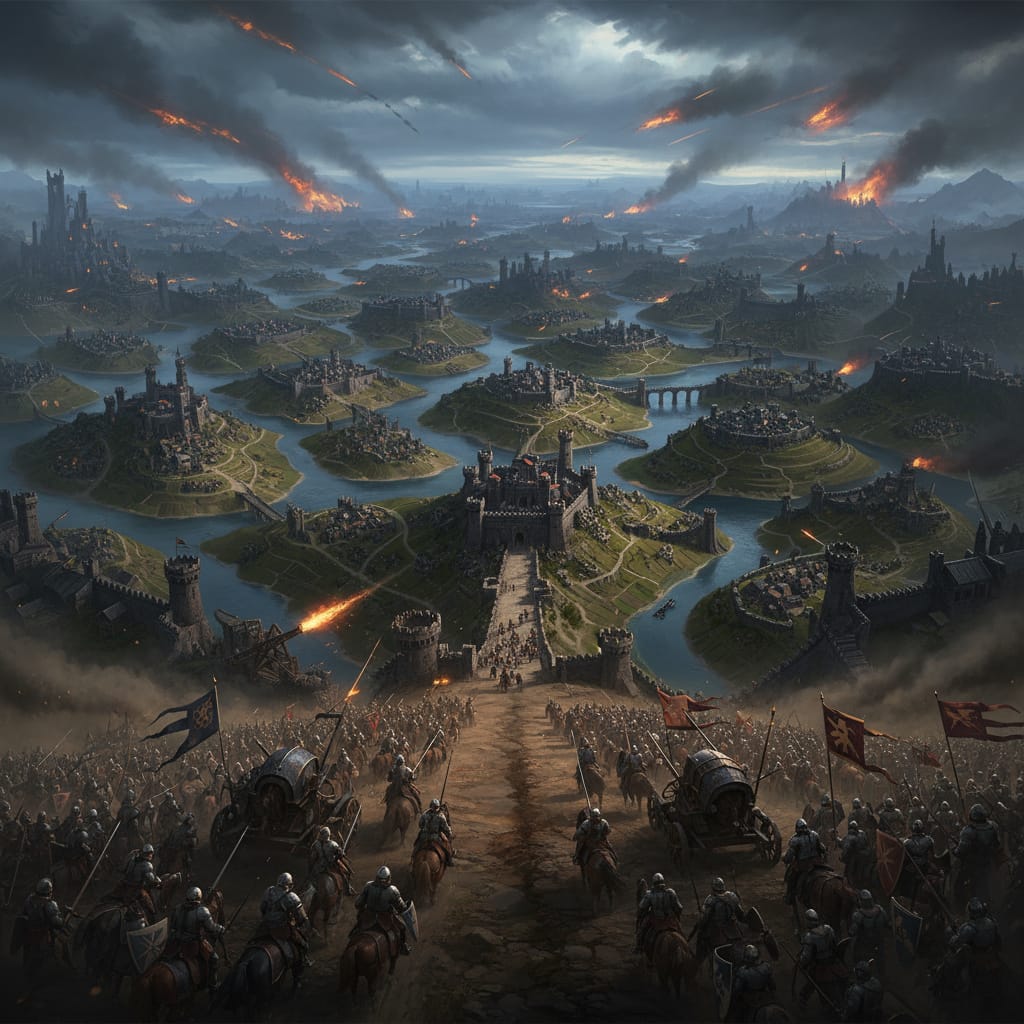
What if the world of Civilization 6 was a single, sprawling landmass, unbroken by oceans, seas, or significant bodies of water? This isn’t just a question of map generation; it’s a fundamental shift in the game’s strategic DNA. The absence of naval power, the reimagining of exploration, and the constant, claustrophobic proximity of every civilization create a gameplay experience that is both intensely aggressive and strategically nuanced. Analysis on forums shows that this scenario is a favorite among players seeking a pure, unadulterated contest of land-based supremacy. This guide delves into the strategic depths of a world without oceans, offering a comprehensive framework for achieving victory when the only way to move is over land.
The New World Order: Understanding the Geo-Strategic Shift
The most immediate and profound change in a landlocked world is the complete irrelevance of naval units and technologies. This has a cascading effect on the entire tech tree and the relative power of certain civilizations. According to the player community, this single change elevates land-based military units from a primary tool of conquest to the only tool of conquest.
Key Environmental Factors:
- No Navies, No Problem: The entire top half of the tech tree, dedicated to seafaring, becomes a strategic dead end. This means no galleys, no caravels for exploration, and no battleships for coastal bombardment. The race to control the seas is replaced by a race to control choke points and strategic resources on land.
- The Rise of the Land Army: Every aspect of military strategy must be re-evaluated. The importance of cavalry for rapid flanking maneuvers, siege units for breaking city defenses, and a strong frontline of melee units cannot be overstated.
- Redefined Exploration: Early game exploration is not about circumnavigating the globe, but about methodically uncovering a vast, contiguous landmass. Scouts are more valuable than ever, and their survival is paramount. Losing a scout in the early game can be a devastating setback.
- Constant Contact, Constant Conflict: With no oceans to act as a buffer, you will meet your neighbors quickly. This makes early diplomacy and military preparedness critical. The “splendid isolation” enjoyed by some civilizations on archipelago or island plates maps is a luxury you cannot afford.
Early Game Strategy: The Mad Dash for Land and Resources
The first 100 turns in a landlocked world are a frantic scramble for territory and resources. Many professional gamers suggest that the early game is more critical in this scenario than in any other. A strong start is not just an advantage; it’s a prerequisite for survival.
Founding Your Capital and First Cities:
- Fresh Water is Still King: While there are no oceans, rivers and lakes are still vital for housing and certain district adjacencies. Prioritize settling your capital on a river.
- Defensive Terrain is Your Best Friend: Hills, forests, and mountains are your natural allies. A capital nestled in a hilly, forested area is far more defensible than one on open plains.
- Resource Prioritization: Strategic resources are the lifeblood of your military. Horses are of paramount importance for early cavalry. Iron is essential for swordsmen and later, more advanced units. A popular strategy is to use your first settler to claim a high-yield resource tile, even if it means a slightly less optimal city location in other respects.
The Art of Land-Based Exploration:
- Scout, Scout, and Scout Some More: Your first build should almost always be a scout. Your second build should probably be another scout. The information they provide is invaluable. You need to know where your neighbors are, where the best city locations are, and where the barbarians are spawning.
- The “Daisy Chain” Method: A popular strategy for exploration is to create a “daisy chain” of scouts. As one scout moves forward, the next follows, creating a continuous line of sight back to your capital. This prevents your scouts from being cut off and destroyed by barbarians.
- –Surviving Barbarians: Barbarians are a much greater threat in a landlocked world. With no oceans to limit their movement, they can swarm you from any direction. A combination of slingers and warriors is essential for fending off early barbarian rushes.
Mid-Game Dominance: Forging an Empire of Steel and Strategy
The mid-game is where the true character of a landlocked world reveals itself. The early game rush for territory gives way to a more calculated game of chess, where strategic positioning, military technology, and economic power determine the winners and losers.
The Centrality of a Strong Military:
- The “Great Wall” of Units: Analysis on forums shows that maintaining a standing army is not just for warfare, but for deterrence. A strong military presence on your borders can dissuade even the most aggressive neighbors from attacking.
- The Holy Trinity of Land Warfare: A balanced army is a winning army. The “holy trinity” of land warfare consists of:
- Melee Units: The backbone of your army, responsible for holding the frontline and capturing cities.
- Ranged Units: Essential for weakening enemy units and city defenses before your melee units engage.
- Cavalry Units: Your primary tool for flanking, pillaging, and chasing down routing enemies.
- Siege is Everything: As cities become more fortified, siege units like catapults, trebuchets, and bombards become absolutely essential. A popular strategy is to have a dedicated corps of siege units that can be moved from one front to another as needed.
Economic and Scientific Development:
- The Engine of War: Your military is only as strong as the economy that supports it. Commercial Hubs and Industrial Zones are not just for generating wealth and production; they are for funding and equipping your armies.
- The Race for Military Technology: The science victory path is still viable, but it must be pursued with a strong military in mind. The race to unlock key military technologies like crossbowmen, knights, and artillery is often more important than the race to the stars.
- Trade in a Landlocked World: Trade routes are exclusively land-based. This makes the roads and trade routes you build even more important. A well-developed network of roads can allow you to move your armies quickly across your empire, responding to threats and launching offensives with greater speed and efficiency.
Late Game Annihilation: The Path to Victory
The late game in a world without oceans is a brutal affair. The map is a patchwork of sprawling empires, and the only way to expand is through conquest. While other victory conditions are technically possible, the game is heavily skewed towards a domination victory.
The Inevitability of Total War:
- The “Final Boss” Mentality: According to the player community, the late game often devolves into a showdown between the two or three most powerful civilizations. You must be prepared to face a “final boss” with a massive army and a sprawling empire.
- The Power of Combined Arms: Late-game warfare is all about combined arms. A well-coordinated attack using infantry, tanks, and artillery is almost unstoppable. Airpower, if you can achieve it, adds another devastating dimension to your offensive capabilities.
- Logistics, Logistics, Logistics: As your armies push deeper into enemy territory, logistics become a major challenge. You need to be able to reinforce your troops, heal your wounded, and keep your supply lines open. A popular strategy is to build a network of forts and airbases as you advance, creating a “lily pad” system for your armies.
Alternative Victory Paths: A Test of Endurance
- The Fortress of Faith: A religious victory is possible, but it requires a different kind of aggression. You must be prepared to defend your religious units as they spread your faith across the continent. A strong military is still essential for protecting your apostles and missionaries from being condemned by heretics.
- The Cultural Citadel: A culture victory is perhaps the most challenging in a landlocked world. You must generate an enormous amount of tourism while fending off the constant threat of invasion. A popular strategy is to focus on building a small number of “super cities” with high culture and tourism output, and then defending them at all costs.
- The Scientific Stronghold: A science victory requires a delicate balance between scientific advancement and military preparedness. You must be able to defend your spaceports from enemy attack while you complete the final stages of the space race. Many professional gamers suggest that a science victory in this scenario is often achieved by a civilization that has already achieved a dominant military position.
The Ultimate Test of Terrestrial Triumph
A world without oceans in Civilization 6 is a world stripped down to its bare essentials. It is a world of pure, unadulterated land-based strategy, where military might, economic power, and strategic cunning are the only things that matter. The absence of naval power does not simplify the game; it intensifies it, creating a more focused and aggressive gameplay experience. From the frantic early game land grab to the brutal late-game wars of annihilation, a landlocked world is the ultimate test of a player’s ability to master the art of terrestrial triumph. The strategies and principles outlined in this guide, drawn from the collective wisdom of the player community, provide a roadmap for not just surviving, but for conquering this unique and challenging environment.