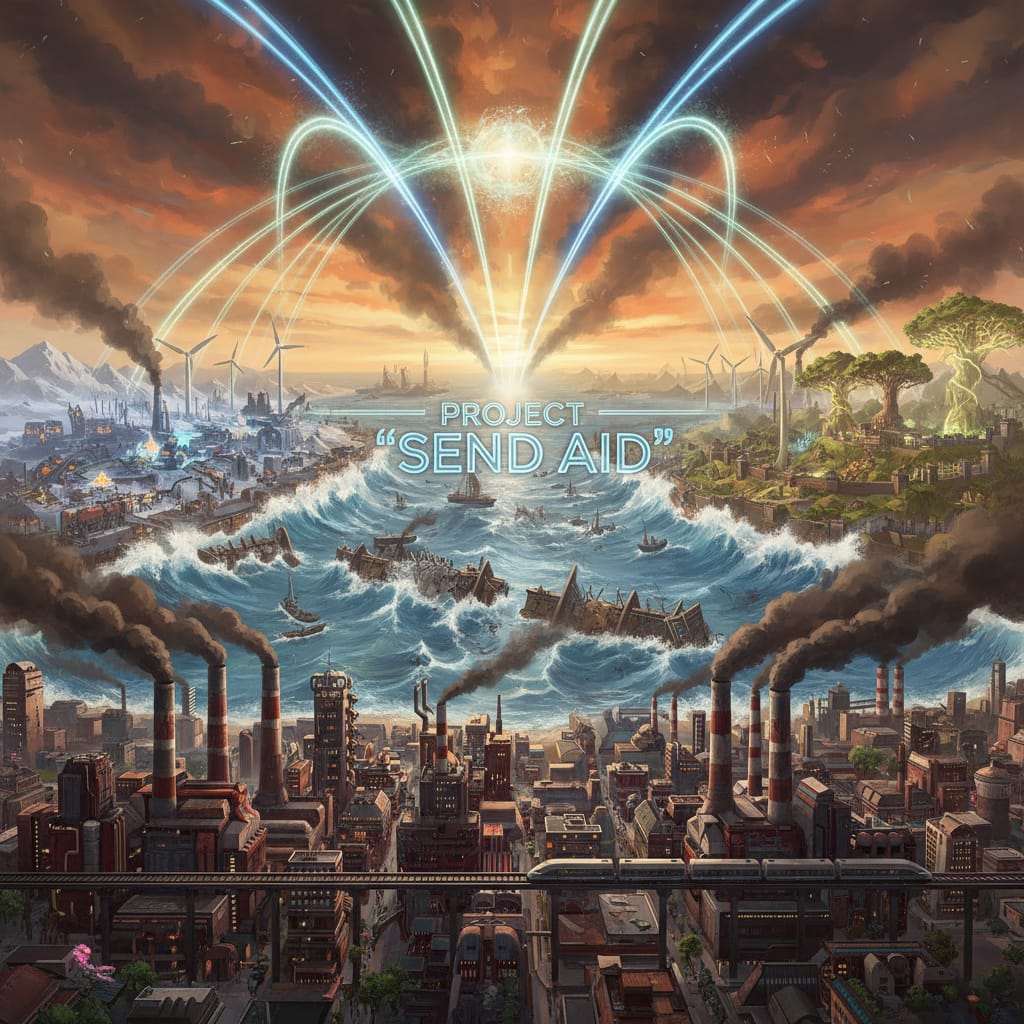
In the grand strategy of Civilization VI, climate change is a creeping threat, a late-game consequence of industrial ambition. Players can build flood barriers, transition to green power, or even run projects to recapture carbon. But what if these options were stripped away? Imagine a world where the rising tides and furious storms could only be held back by a single, concerted effort: the “Send Aid” city project. This isn’t about sending gold to a disaster-stricken rival anymore. In this scenario, “Send Aid” becomes a global climate initiative, the only tool humanity has to scrub CO2 from the atmosphere and prevent planetary catastrophe.
This fundamental shift would rewrite the strategic playbook from the Ancient Era to the Future Era. Production would become synonymous with planetary salvation, and the choices made in the Industrial Era would carry a weight far beyond mere economic advantage. This guide explores the complex strategic landscape of this hypothetical Civilization VI, offering an in-depth analysis of how to navigate a world where the “Send Aid” project is humanity’s last hope.
The New Global Imperative: Redefining “Send Aid”
In this altered reality, the “Send Aid” project is no longer a minor feature of the World Congress. It is a permanent, repeatable city project available from the Industrial Era onwards. Its function is simple and direct: for every turn a city dedicates its production to “Send Aid,” it removes a set amount of CO2 from the global total. The project does not generate gold or diplomatic favor in the traditional sense. Its only reward is the survival of the planet.
This change introduces a new central tension to the game: Production vs. Pollution. Every unit built, every coal power plant fired up, every forest chopped contributes to the rising CO2 levels. The only way to counteract this is to dedicate your precious production—the very engine of your civilization’s growth—to the “Send Aid” project. This creates a dynamic where the most industrially advanced civilizations are both the greatest polluters and the only potential saviors.
Early Game Foundations: Preparing for the Inevitable Storm
Even though the “Send Aid” project only becomes available in the Industrial Era, the groundwork for success is laid much earlier. Analysis on forums shows that players who neglect their production infrastructure in the early game will be powerless to stop climate change later on.
Strategic City Placement and Development
- Prioritize Production Tiles: From your very first settler, your evaluation of city locations must change. Hills, woods, and strategic resources that boost production are no longer just “good to have”; they are essential. A city with a high base production will be a climate-saving powerhouse in the late game.
- The Magnus-Industrial Complex: The Governor Magnus, with his “Provisions” promotion, is already a powerful tool for expansion. In this scenario, his ability to harvest resources without removing features becomes critical. Chopping rainforests for a quick production boost is a short-term gain that accelerates the long-term crisis. Magnus allows you to get the production you need without adding to the CO2 burden.
- Builder Management: Your builders should be focused on creating mines, lumber mills, and other production-enhancing improvements. Farms are necessary for growth, but a city that can’t build anything is a liability. According to the player community, a common mistake is to over-focus on food and housing, only to find your cities are unable to contribute meaningfully to the “Send Aid” effort.
The Industrial Era Fork: To Pollute and Pay, or to Grow Green?
The discovery of coal marks the beginning of the climate crisis. At this point, every civilization must make a fundamental choice, a strategic fork in the road that will define the rest of their game.

The “Pollute and Pay” Strategy
This high-risk, high-reward strategy involves embracing fossil fuels to create a massive industrial base. The thinking is simple: build the most powerful production engine possible, even if it means maxing out the CO2 meter, and then use that engine to out-produce the problem.
- Core Tenets: Build Coal Power Plants in every city. Churn out Industrial Zone buildings. Use military engineers to build factories and railroads. The goal is to achieve an overwhelming production advantage that can be pivoted to “Send Aid” projects when the crisis becomes dire.
- Civilization Synergy: Civilizations like Germany, with its extra district slot and powerful Hansa, are perfectly suited for this strategy. Japan’s Meiji Restoration adjacency bonuses also create incredibly potent industrial hubs.
- The Risk: This is a race against time. If you cannot pivot your production to “Send Aid” fast enough, you will drown. Coastal cities will be the first to go, and the increased frequency of natural disasters can cripple your carefully constructed industrial machine. Many professional gamers suggest that this strategy is only viable if you have a significant scientific lead, allowing you to unlock advanced production-boosting technologies before the worst effects of climate change hit.
The “Green Growth” Strategy
This strategy involves actively avoiding fossil fuels and seeking alternative paths to growth. It is a slower, more deliberate approach that prioritizes sustainability over short-term power.
- Core Tenets: Avoid building Coal Power Plants. Instead, rush for technologies that allow for renewable energy sources like dams and geothermal plants. Focus on civics that grant bonuses for having happy, well-amenitied cities. Preserve forests and plant new ones.
- Civilization Synergy: Civilizations that can thrive without heavy industry, like the Inca with their Terrace Farms and unique mountain-based gameplay, are strong contenders for this strategy. Canada’s ability to build farms in the tundra and its bonuses for avoiding surprise wars also fit well with a more peaceful, sustainable approach.
- The Challenge: The primary challenge of “Green Growth” is keeping up. While you are carefully managing your carbon footprint, your “Pollute and Pay” rivals are building massive armies and racing ahead in science. A popular strategy is to leverage diplomacy, forming a bloc of “green” nations to diplomatically punish the polluters through the World Congress.
High-Production Civilizations: The Unlikely Saviors
In this hypothetical, certain civilizations and leaders are thrust into the role of planetary saviors due to their innate production advantages.
- Germany (Frederick Barbarossa): The Hansa, Germany’s unique Industrial Zone replacement, is the cornerstone of any “Send Aid” strategy. The ability to place an extra district in each city allows Germany to build both a powerful economy and a strong military, and then pivot that industrial might to saving the world.
- Japan (Hojo Tokimune): Japan’s “Meiji Restoration” ability, which grants adjacency bonuses for districts placed next to each other, can create incredibly dense and productive cities. A well-planned Japanese city with a Government Plaza, an Industrial Zone, and a Commercial Hub can become a production powerhouse.
- Russia (Peter the Great): Russia’s “Mother Russia” ability, which grants extra production and faith from tundra tiles, makes it a surprisingly effective “Send Aid” civilization. While other civs struggle with the sparse resources of the tundra, Russia can build sprawling, productive cities that can dedicate themselves to the climate effort.
- Gaul (Ambiorix): Gaul’s ability to get adjacency bonuses from mines and quarries, combined with their unique Oppidum district, gives them a massive mid-game production spike. They can build a powerful military to defend themselves and then transition that production to “Send Aid” projects.
Diplomacy in a Drowning World: The World Congress as a Battleground
The World Congress would be transformed from a forum for minor boons and grievances into the central arena for global survival. The resolutions passed here could mean the difference between a stable planet and a watery grave.
- New Resolutions: Expect to see new, climate-focused resolutions. A “Global Carbon Tax” could punish civilizations with high CO2 emissions by draining their gold reserves. A “Green Energy Initiative” could provide a production bonus towards “Send Aid” projects for all civilizations.
- Bloc Formation: The world would naturally divide into two blocs: the “Industrialists,” who want to continue polluting for their own gain, and the “Preservationists,” who are desperately trying to hold back the tide. Diplomatic favor would become a critical resource, and the competition to become Suzerain of city-states that grant extra favor would be fierce.
- Weaponizing Aid: A cunning player could use the “Send Aid” project as a diplomatic weapon. Imagine a scenario where one continent is home to the world’s worst polluters. A coalition of nations on another continent could dedicate their production to “Send Aid,” effectively saving themselves while allowing their rivals to drown. This creates a grim new form of global politics.
War for the World’s Future: New Justifications for Conflict
Warfare would also take on a new dimension. The traditional casus belli would still exist, but they would be joined by a new, all-important justification: the “War for Planetary Salvation.”
- The Anti-Pollution Crusade: A civilization leading the “Send Aid” effort could gain a powerful casus belli against the world’s worst polluter. This would allow them to launch a war with reduced grievances, framed as a necessary evil to save the planet.
- Targeting Production: Military strategy would shift. Instead of just capturing capitals, a key objective would be to pillage or capture your enemy’s high-production cities. Crippling a rival’s ability to run “Send Aid” projects could be a death sentence for their coastal territories.
- The Scorched Earth Dilemma: A desperate, losing civilization might be tempted to engage in a “scorched earth” policy, deliberately polluting as much as possible to ensure that if they can’t win, everyone loses. This would make late-game wars incredibly tense and high-stakes.
Victory in the Balance: A New Path to Every Victory Type
This single change to the “Send Aid” project would have a profound impact on every victory condition, weaving the climate crisis into the fabric of the entire game.

- Science Victory: The race to space becomes a race for survival. Advanced technologies might unlock more efficient versions of the “Send Aid” project, or perhaps even a one-time “miracle” technology that can reverse climate change. The civilization that gets there first could hold the fate of the world in its hands.
- Culture Victory: A civilization that dedicates itself to the “Send Aid” effort could gain a massive tourism boost. They would be seen as the saviors of the world, and their culture would become incredibly appealing. Imagine the tourism generated by the “Great Climate Savior” national park.
- Domination Victory: The “Pollute and Pay” strategy is a high-risk path to a Domination Victory. A player could build a massive army, conquer their rivals, and then, as the sole remaining superpower, dedicate their entire global empire to “Send Aid” projects to clean up the mess they created.
- Diplomatic Victory: This victory condition would be the most transformed. Winning a “Send Aid” competition would no longer be about giving gold; it would be about contributing the most production to the global effort. The leader of the “Preservationist” bloc, the one who consistently pushes for green policies in the World Congress, would be the clear frontrunner for a Diplomatic Victory.
A World of Consequence
Shifting the function of the “Send Aid” project to be the sole solution to climate change would create a more dynamic, high-stakes, and strategically complex version of Civilization VI. It would force players to confront the consequences of their industrial ambitions in a direct and unavoidable way. The familiar rhythms of the game would be altered, and new strategies would emerge from the rising tides. In this world, production is not just the engine of empire; it is the price of survival. The civilizations that can balance their ambition with their responsibility, their growth with the health of the planet, will be the ones to truly stand the test of time.