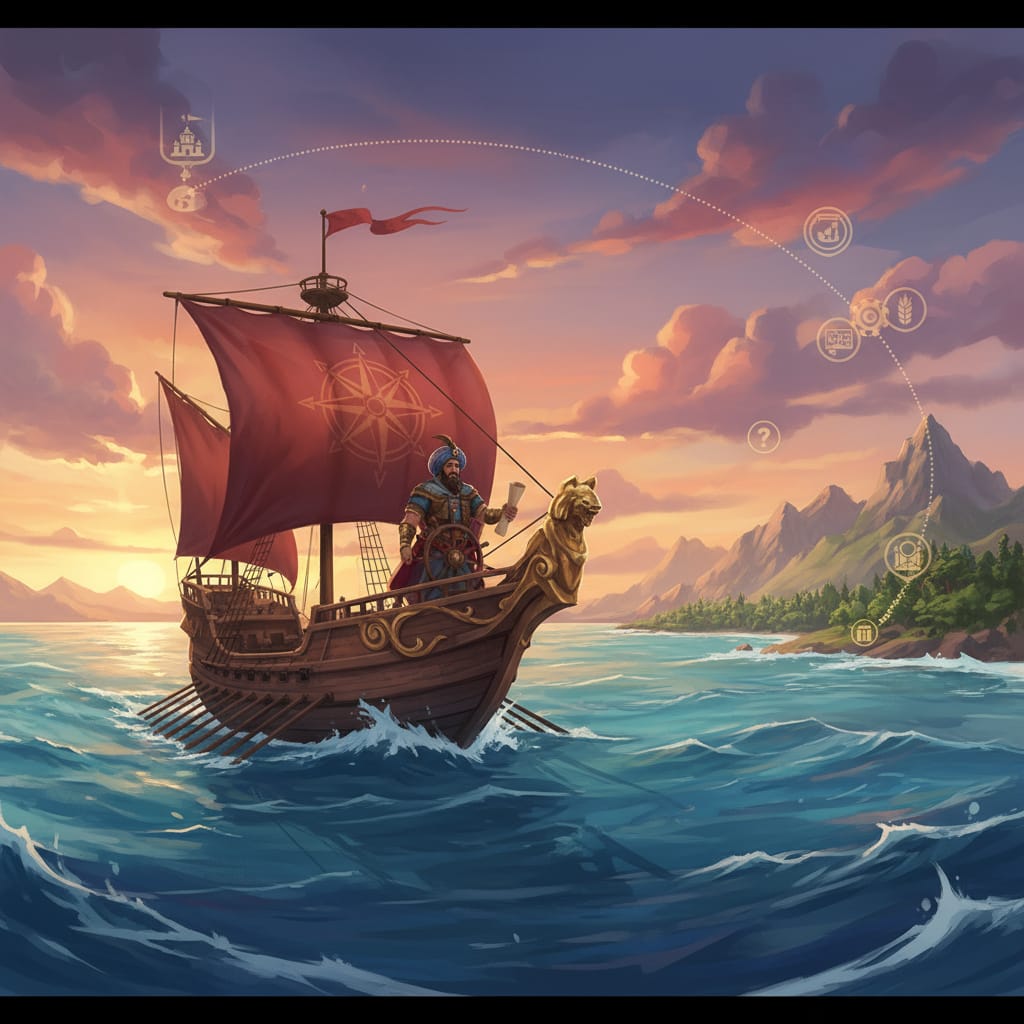
In the grand tapestry of Civilization 6, where every decision can ripple through millennia, the Heroes & Legends game mode introduces figures of myth and history to reshape the strategic landscape. Among these, Sinbad the Sailor stands unique, a master of the seas whose voyages generate immense wealth. However, a fascinating hypothetical scenario has emerged from community discussions and strategic forums: What if Sinbad’s ultimate journey, a full circumnavigation of the globe, yielded not just gold, but the ultimate prize of a free Settler? This single change would radically alter the calculus of naval exploration, transforming an early-game gambit into a civilization-defining quest. Analysis on forums shows that such a reward would catapult the lucky civilization into a golden age of expansion, leaving rivals struggling to catch up. This guide delves into the strategic depths of this powerful “what if,” exploring how to maximize its potential and dominate the world.
The Golden Quest: Acquiring Sinbad and the Immediate Pivot
The quest for the circumnavigation settler begins in the Ancient Era. According to the player community, the appearance of Heroes is a moment of pure opportunity, and securing Sinbad is the first critical step. He can be discovered through Tribal Villages, by being the first to be suzerain of a city-state, or by discovering a continent or natural wonder. From the moment Sinbad is claimed, the strategic priority of the civilization must pivot. While other leaders are focused on early wonders, military rushes, or securing key city-state alliances, the player with Sinbad has a singular, overarching objective: get him on the water and sailing.
A popular strategy is to immediately use Sinbad’s impressive 7 movement points and his ability to enter ocean tiles from the start of the game to begin a circumnavigation attempt. This is a high-risk, high-reward play. The risks are numerous: barbarian galleys, the unknown dangers of the open ocean, and the opportunity cost of not using Sinbad to clear nearby barbarian camps for his gold-generating “Sinbad’s Fortunes” ability. However, the potential reward of a free settler is so immense that it justifies the risk. Many professional gamers suggest that the gold earned from discovering new continents and natural wonders along the way can be used to purchase a builder or even a slinger to defend the homeland while Sinbad is on his epic journey. This mitigates the risk of falling behind in the early game.
The decision of which direction to send Sinbad is a critical one. Analysis on forums shows that a horizontal circumnavigation (east to west or west to east) is generally faster and less likely to be blocked by polar ice than a vertical one. The choice of direction should be informed by the starting location. If the player starts on the east coast of a continent, sending Sinbad east into the unknown is the logical choice. If on the west coast, he sails west. The key is to commit to a direction and maintain a consistent course, only deviating to grab easily accessible tribal villages or to avoid immediate threats.
Navigating the Unknown: Strategies for a Swift Circumnavigation
Once Sinbad is at sea, the race against time begins. The goal is to complete the circumnavigation as quickly as possible to get the free settler on the board and start reaping its benefits. The player community has developed several strategies for optimizing this journey.
First and foremost is the principle of “hugging the coast, but not too tightly.” This means staying close enough to the coastline to reveal the shape of the continents and avoid getting lost in the vast emptiness of the ocean, but not so close that Sinbad is slowed down by having to navigate every inlet and bay. A popular strategy is to move Sinbad in a “sawtooth” pattern, alternating between moving one tile away from the coast and one tile back towards it. This allows for a good balance of speed and information gathering.

Another key strategy is to use Sinbad’s “Sinbad’s Fortunes” ability strategically. While it’s tempting to use it on every barbarian camp encountered, this can slow down the circumnavigation. Many professional gamers suggest saving this ability for situations where it can clear a path, such as a barbarian galley blocking a narrow channel, or for high-value targets like a barbarian camp that is about to spawn a naval unit that could threaten Sinbad. The gold earned from these encounters is a secondary benefit; the primary goal is to keep moving.
The map type plays a huge role in the feasibility and speed of circumnavigation. On a Pangaea map, a sea-based circumnavigation is impossible, but a land-based one might be. However, the hypothetical scenario specifies Sinbad, a naval unit, so this strategy is most viable on maps with large oceans, such as Continents, Small Continents, or Archipelago. Analysis on forums shows that on a standard Continents map, a skilled player with a bit of luck can achieve circumnavigation in the Classical or even late Ancient Era. This is the sweet spot for the free settler to have the most dramatic impact.
The Ultimate Prize: The Impact of the Free Settler
The moment Sinbad completes his journey and the free settler appears in the capital is a game-changing event. In the early game, a free settler is arguably the most powerful reward a player can receive. It represents a massive injection of tempo and a significant acceleration of the civilization’s growth curve.
The immediate benefit is the ability to found a new city without the usual costs. Producing a settler normally requires a significant investment of production, and more importantly, it reduces the population of the city that builds it by one. A free settler bypasses both of these costs. This means the capital can continue to grow and produce other vital things like builders, military units, or districts, while a new city is established, immediately starting to contribute to the empire’s yields.
The strategic placement of this new city is a critical decision. Many professional gamers suggest using the free settler to claim a strategic location that might otherwise be lost to a rival civilization. This could be a spot with multiple luxury resources, a natural wonder, or a defensive chokepoint. Alternatively, the settler could be used to forward-settle a rival, putting pressure on their borders and restricting their expansion. The information gathered by Sinbad during his circumnavigation is invaluable here. The player will have a much better understanding of the world map than their rivals and can make a more informed decision about where to place their new city.
The free settler also has a significant impact on the player’s Era Score. Founding a new city, especially on a new continent, generates a significant amount of Era Score, making it much more likely that the player will achieve a Golden Age. A Golden Age in the Classical or Medieval Era, fueled by the early expansion from the free settler, can create a snowball effect that is very difficult for other civilizations to stop.

The Snowball Effect: Mid-Game Dominance
The initial advantage of the free settler continues to compound in the mid-game. The extra city founded in the early game will have had time to grow, build districts, and start producing significant yields of science, culture, gold, and faith. This will put the player with the Sinbad settler significantly ahead of their rivals on the technology and civics trees.
Analysis on forums shows that a player who gets an early free settler is often the first to unlock key mid-game technologies and civics. This could mean being the first to get to powerful military units like Knights or Crossbowmen, or the first to unlock key economic bonuses like guilds or mercantilism. This technological and civic advantage can be used to further press the advantage, whether through military conquest, economic dominance, or cultural influence.
The extra city also provides a platform for further expansion. With a stronger economy and a larger population, the player will be able to produce settlers more quickly and continue to expand their empire. The information from Sinbad’s circumnavigation is once again crucial here. The player will know where the best unsettled lands are, and can direct their expansion accordingly.
A popular strategy in the mid-game is to use the economic and scientific advantage to build a powerful navy. With Sinbad’s legacy of naval exploration, it is thematically and strategically appropriate to focus on controlling the seas. A strong navy can be used to protect trade routes, project power across the globe, and even launch naval invasions of rival civilizations. The gold generated by Sinbad in the early game can be used to purchase naval units or upgrade existing ones, further cementing the player’s naval superiority.
The Unstoppable Force: Late-Game Ascendancy
By the late game, the civilization that secured the Sinbad settler will be in a commanding position. The early expansion and the snowball effect of the mid-game will have translated into a large, powerful, and technologically advanced empire. The advantages gained in the early and mid-game are not easily overcome, and the player will be well on their way to achieving any of the victory conditions.
For a Science Victory, the extra cities and the strong economy will provide the production and science yields needed to complete the space race projects. For a Culture Victory, the larger empire will have more slots for great works and more tourism-generating wonders. For a Domination Victory, the technological and economic advantages will translate into a superior military that can conquer the world. And for a Diplomatic Victory, the player’s global presence and strong economy will make them a powerful force in the World Congress.
The legacy of Sinbad’s circumnavigation will be visible across the globe. The player’s empire will be a sprawling, intercontinental power, with cities on multiple continents and a navy that rules the waves. The free settler, a single unit granted in the mists of the Ancient Era, will have been the catalyst for this global dominance.
Countering the Sinbad Strategy: A Rival’s Guide
For players who find themselves in a game where a rival has secured Sinbad and is attempting a circumnavigation, all is not lost. There are strategies that can be employed to mitigate the advantage of the free settler.
The most direct counter is to try and intercept and capture Sinbad. This is a difficult task, as Sinbad is fast and can heal in neutral territory. However, a well-placed galley or a surprise attack from a barbarian ship could potentially put an end to his voyage.
Another strategy is to try and beat the Sinbad player to the best city locations. If a player suspects that a rival is going for a circumnavigation, they should immediately prioritize their own expansion and try to claim as much land as possible. This will limit the value of the free settler when it eventually arrives.
Finally, players can try to form an alliance against the Sinbad player. If one civilization is clearly pulling ahead, the other civilizations have a vested interest in working together to bring them down. This could involve a joint war, a trade embargo, or a coordinated effort to vote against them in the World Congress.
Conclusion
The hypothetical scenario of Sinbad the Sailor gaining a free settler for circumnavigating the globe is a fascinating one to consider. It is a change that would elevate naval exploration from a secondary pursuit to a primary strategic objective in the early game. The player who could successfully pull off this gambit would be rewarded with a massive and potentially insurmountable advantage. The free settler would be the seed from which a global empire would grow, a testament to the power of a single, well-executed voyage. While this remains a “what if” for now, it serves as a powerful reminder of the delicate balance of strategy and opportunity that makes Civilization 6 such an endlessly compelling game. The community’s analysis is clear: such a bonus would not just be strong, it would be legendary.