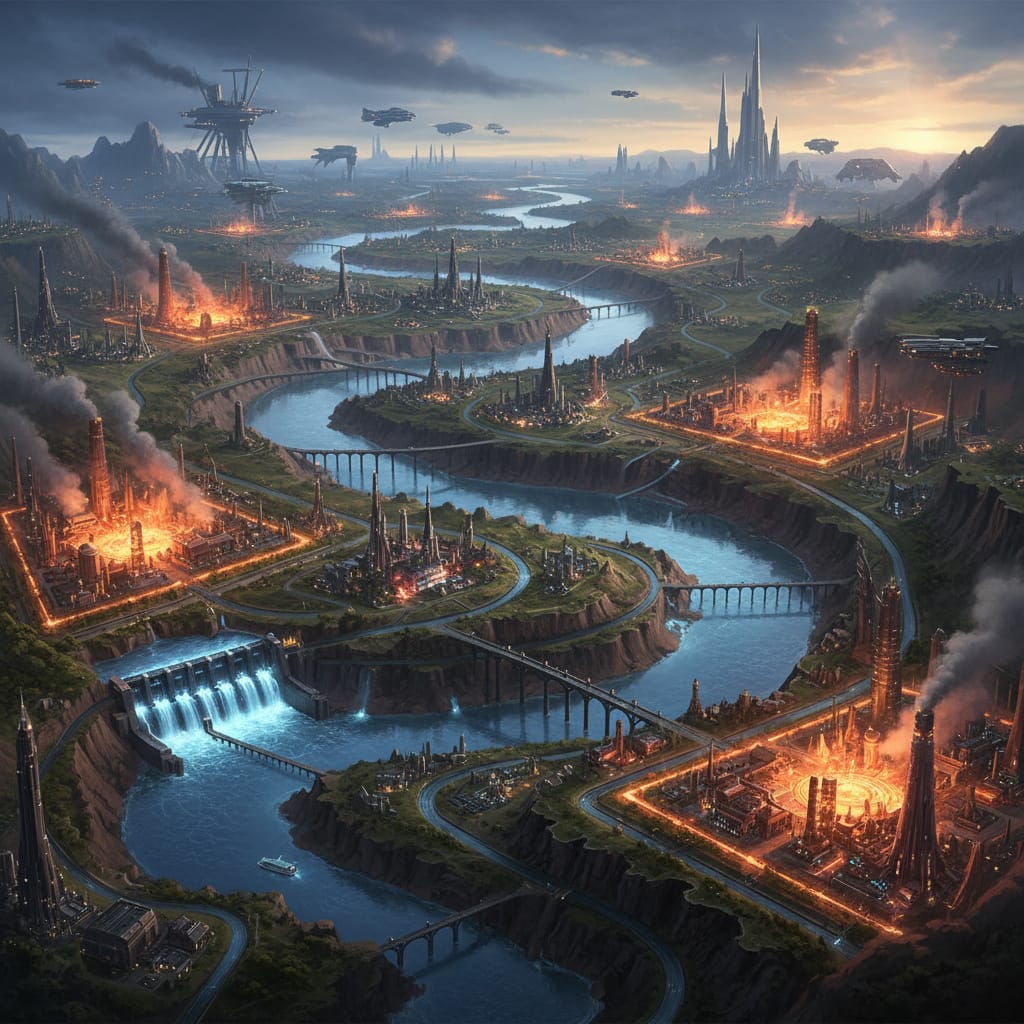
The strategic landscape of Civilization VI is a complex tapestry woven from rules, resources, and the ingenuity of its players. Every district placement, every wonder built, and every tile improved is a calculated decision with cascading effects. Among the most impactful of these decisions is the placement of the Dam district. In the current state of the game, Dams are a rare and precious commodity, shackled by strict placement requirements: they can only be built on Floodplains tiles where a river passes through at least two edges of the hex. But what if this fundamental rule was broken? What if Dam districts could be built on any river tile?
This seemingly simple change would not merely be a quality-of-life improvement; it would represent a seismic shift in the very foundations of city planning, economic strategy, and even military preparation. The ripple effects would be felt from the ancient era to the information era, redefining the value of river systems and unlocking production potential previously unimaginable. Analysis on forums shows that such a change would elevate rivers from valuable assets to the undisputed lifeblood of any thriving empire, fundamentally altering the calculus of power and progress. This guide explores the profound strategic implications of this hypothetical scenario, offering a detailed analysis of how players would adapt and thrive in a world where the power of rivers is truly unleashed.
The Industrial Revolution Reimagined: Unleashing Production Power
The most immediate and dramatic impact of flexible Dam placement would be the radical transformation of Industrial Zone adjacency bonuses. According to the player community, the pursuit of high-adjacency Industrial Zones is already a cornerstone of high-level play. The standard +2 bonus from a single Dam is a coveted prize. In a world where Dams are no longer constrained by the whims of floodplain generation, the potential for production explodes.
The “Golden Triangle” Becomes the Standard
A popular strategy among professional gamers is the creation of a “golden triangle” (or diamond) of districts: an Industrial Zone perfectly situated between an Aqueduct and a Dam. This configuration provides a baseline of +4 production before factoring in other districts or resources. With the freedom to place Dams on any river tile, this powerful setup would become not just a possibility, but a standard and easily achievable goal for nearly every city with access to a river.
- Universal High-Adjacency: Cities would no longer be at the mercy of map generation for their industrial potential. Any city settled on a river could, with proper planning, construct a high-powered Industrial Zone. The current disparity between cities with lucky floodplain spawns and those without would largely disappear, creating a more balanced and predictable industrial landscape across an empire.
- The Rise of the +7 IZ: The theoretical maximum adjacency for an Industrial Zone would become far more attainable. Imagine a scenario, frequently discussed in strategic forums: an Industrial Zone surrounded by a Dam, an Aqueduct, a Canal, and two other districts. This would yield a staggering +7 adjacency bonus (+2 from the Dam, +2 from the Aqueduct, +2 from the Canal, and +1 from the two additional districts). With the policy card that doubles adjacency bonuses, this becomes a +14 production bonus from adjacency alone—a city-state-level output from a single district.
Strategic City Placement: The River is King
The ability to place Dams anywhere along a river would fundamentally rewrite the rules of city placement. While freshwater has always been a priority for housing, this change would make proximity to a river the single most important factor for long-term city viability and specialization.
- Linear City Planning: Players would likely adopt a more linear approach to city settlement, tracing the paths of major river systems. The goal would be to maximize the number of cities that can leverage a single, sprawling river for their industrial complexes. Analysis on forums shows that players would prioritize settling locations that allow for the creation of interlocking zones of industrial power.
- The End of “Bad” River Starts: In the current game, a river that flows through flat, featureless terrain with no floodplains is often seen as a missed opportunity. In our hypothetical scenario, every inch of that river becomes prime real estate. A city could be settled specifically to place a Dam on a strategically advantageous tile, even if the surrounding terrain is otherwise unremarkable. This turns previously ignored locations into potential industrial powerhouses.
Economic and Military Dominance Through Engineering
The widespread availability of high-production cities would have profound implications for an empire’s economic and military might. The ability to rapidly produce units, buildings, and wonders would accelerate the pace of the game and create new strategic possibilities.

The Unstoppable Production Engine
Many professional gamers suggest that the key to victory is often a mid-game production surge. With universally powerful Industrial Zones, this surge would become a tidal wave.
- Wonder Proliferation: The construction of wonders, particularly those in the mid to late game, would become a far more common occurrence. A network of high-production cities could churn out wonders at an astonishing rate, allowing a single player to dominate the race for these powerful game-changing assets. Wonders like the Ruhr Valley, which provides a +20% production bonus in its city, would become even more potent when built in a city already boasting a +14 adjacency bonus.
- Military Mass Production: The ability to rapidly produce military units cannot be overstated. An empire with a network of high-production cities could field massive armies in a fraction of the time it currently takes. This would make offensive wars more decisive and defensive wars more resilient. A popular strategy would likely involve dedicating specific cities along a river system to constant unit production, creating a “conveyor belt” of military power that could overwhelm even the most fortified opponent.
The Economic Power of Water Management
Beyond direct production, the increased availability of Dams would have a significant impact on a civilization’s overall economic health.
- Energy for All: Each Dam provides +3 Power to its city, a crucial resource in the late game. With Dams becoming a standard feature of every riverside city, the need to build polluting power plants like Coal and Oil would be significantly reduced. This would not only have positive environmental effects (reducing CO2 emissions and the impact of climate change) but also free up strategic resources and production for other purposes. A civilization could potentially power its entire empire through a network of hydroelectric dams, achieving a level of energy independence that is currently very difficult to attain.
- Amenity and Housing Security: Each Dam also provides +1 Amenity and +2 Housing. While seemingly minor, these bonuses add up significantly when multiplied across an entire empire. The consistent stream of amenities would help to keep populations happy and productive, while the extra housing would facilitate taller, more populous cities. This reduces the need to dedicate district slots to Entertainment Complexes or build as many Granaries, freeing up production for more impactful investments.
New Strategic Considerations and Counter-Plays
Of course, in the ever-evolving game of Civilization VI, no single strategy exists in a vacuum. The newfound power of rivers would inevitably lead to new forms of competition and new strategic considerations.
The Race for River Real Estate
The early game would likely see an even more intense “land grab” than what currently exists. The most valuable territory would no longer be defined by luxury resources or natural wonders alone, but by the length and complexity of its river systems.
- Forward Settling and River Control: Players would be incentivized to forward-settle their opponents to claim control of critical river junctions. A single city placed strategically upstream could deny an opponent the ability to build their own network of Dams and Industrial Zones, effectively crippling their long-term production potential. This would make early-game scouting and settler protection more important than ever.
- The Value of Encampments: Encampments would become crucial tools for asserting control over contested river valleys. A well-placed Encampment, with its ability to exert zone of control and house a garrison, could protect a player’s planned industrial heartland from enemy incursions.
Countering the Production Juggernaut
Facing an opponent with a fully developed river-based production engine would be a daunting prospect. However, the player community has always been adept at developing counter-strategies.
- Espionage and Sabotage: Spies would become an essential tool for disrupting an opponent’s industrial machine. The “Sabotage Production” mission, which pillages an Industrial Zone and halts production in the city, would be a devastatingly effective way to slow down a production juggernaut. A coordinated campaign of espionage, targeting an opponent’s most productive cities, could be the key to leveling the playing field.
- Strategic Bombing and Air Power: In the late game, air power would be the most direct counter to entrenched industrial complexes. A squadron of bombers could systematically pillage an opponent’s Dams, Aqueducts, and Industrial Zones, bringing their production to a grinding halt. This would make the development of an air force and the construction of anti-air defenses a top priority for any player relying on a river-based strategy.
A New Era of Civilization
The ability to build Dams on any river tile would be more than a simple rule change; it would be a paradigm shift. It would elevate the strategic importance of rivers to unprecedented heights, transforming them from valuable geographic features into the central pillars of empire-building. The game would become a dynamic struggle for control of these vital waterways, with players leveraging their newfound engineering prowess to forge mighty industrial empires. While the fundamental goals of Civilization VI would remain the same—to build a civilization that can stand the test of time—the path to victory would be irrevocably altered, flowing along the banks of a thousand powerful rivers. The strategies and tactics that would emerge in this new world would be a testament to the endless ingenuity of the player community, forever changing the way we think about the power of production and the art of civilization building.