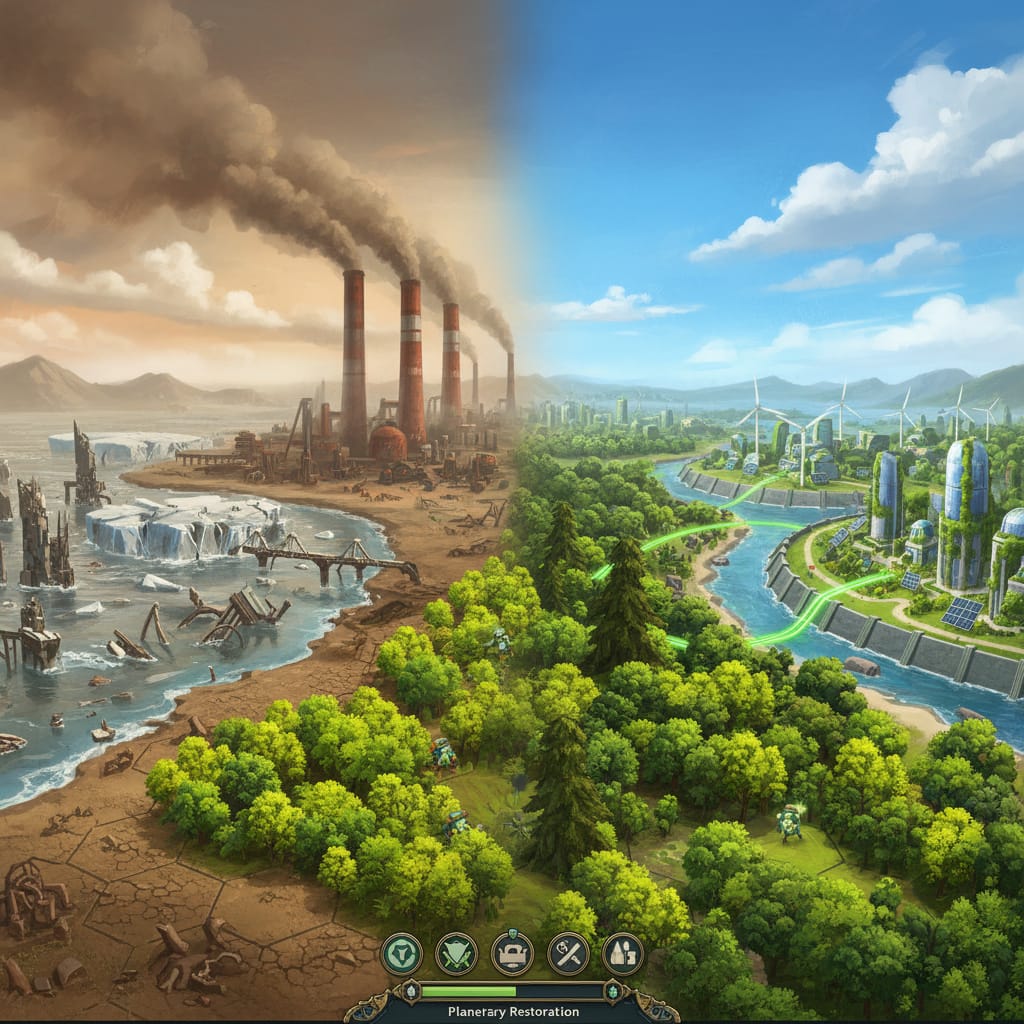
In the world of Civilization VI: Gathering Storm, the march of progress leaves a dark and indelible mark on the planet. As smokestacks rise and armies consume the world’s resources, the polar ice caps melt, and the seas begin to claim the coasts. Climate change is a relentless, forward-moving force, a problem to be managed with flood barriers and, eventually, partially mitigated with late-game technology. But what if it wasn’t? What if players had a tool, available from the mid-game, to not just slow but actively reverse the damage? This is the strategic paradigm we will explore: a world where the simple act of planting a forest becomes a powerful weapon against global warming.
This guide delves into a hypothetical, yet game-changing, mechanic: the ability for planted woods to sequester CO2 and roll back the phases of climate change. We will analyze how this single alteration would fundamentally reshape every era of play, from opening build orders to late-game victory pushes. According to extensive analysis on player forums, such a change would introduce a profound new layer of strategic trade-offs, diplomatic maneuvering, and civilization-defining choices. Many professional gamers suggest that the current model, while realistic in its inexorability, misses a key element of environmental strategy: active restoration. If builders could reclaim the land not just for production or appeal, but for the very survival of the planet, the entire strategic landscape of Civilization VI would be reborn.
The New Environmental Calculus: Understanding Afforestation as a Reversal Tool
To analyze this “what if” scenario, we must first establish a plausible framework for how this mechanic would function, based on existing game systems. Player community discussions often center on a balanced, scalable approach rather than an instant-fix button.
Hypothetical Mechanic: CO2 Sequestration by Woods
A popular theory suggests that each “Second-Growth” forest planted by a builder after researching the Conservation civic would initiate a small but significant reversal of CO2 emissions. The key elements would be:
- Initial Sequestration: Upon planting a new forest, a one-time lump sum of CO2 is removed from the global total. Community analysis suggests a figure between 10 and 20 CO2 units per forest would be impactful without being overpowered. This immediately rewards the investment of a Builder charge.
- Ongoing Absorption: More critically, each tile of Woods (both Old-Growth and Second-Growth) would provide a small, passive, per-turn reduction in a civilization’s net CO2 output. For example, each forest tile could reduce a civilization’s CO2 footprint by 0.5 units per turn. This transforms every forest on the map from a simple production or appeal bonus into an active part of your environmental infrastructure.
- Maturity Bonus: To add strategic depth, many players propose a “maturity” system. A Second-Growth forest, after standing for a certain number of turns (e.g., 20), would mature into an “Old-Growth” forest, doubling its passive CO2 absorption rate. This would incentivize long-term planning and the protection of established woodlands.
Under this system, climate change is no longer a one-way street. A civilization could, with concerted effort, actively lower the global temperature and even reclaim submerged coastal tiles by bringing the world back through the phases of climate change. This sets the stage for a completely new set of strategic considerations.

Early Game (Ancient to Medieval Era): Proactive Land Management
Even though the ability to plant woods wouldn’t unlock until the Modern Era, this hypothetical change would cast a long shadow over early-game decisions. Analysis on forums shows that top-tier players would immediately adapt their long-term planning.
The Chopping Dilemma Magnified
The decision to chop a forest for a quick production boost is already a significant trade-off. With our new mechanic, it becomes monumental. Removing an Old-Growth forest would now mean sacrificing not just future production and appeal, but also a valuable source of passive CO2 absorption that will become critical later.
- Strategic Preservation: A popular strategy would likely emerge to identify and preserve large tracts of ancient forest. Settling cities to encompass these areas would become a high priority, not just for Lumber Mills, but as a pre-built carbon sink.
- Wonder and District Planning: Players would have to weigh the immediate benefit of chopping woods to rush a wonder like the Pyramids against the long-term environmental cost. A player might choose a slower, more sustainable build path, using Magnus’s “Provision” promotion for settlers without chopping, to preserve their environmental assets.
Settlement and Expansion
The value of land would be re-evaluated. A flat, featureless plain, normally considered prime for district placement, might be seen as less valuable than a tile with hills and forests.
- “Green” Settling: Expect to see players settling in less-than-ideal locations simply to secure large forested areas. The long-term strategic benefit of controlling a future carbon-capture zone would outweigh the short-term loss of a few food or production yields.
- Targeted Clearing: Instead of wholesale deforestation, players would adopt a surgical approach. Only the specific tiles needed for districts would be cleared, leaving the surrounding woods intact. The Settler lens would be used not just to see fresh water, but to identify areas where districts could be placed with minimal environmental impact.
Mid-Game (Renaissance to Industrial Era): The Afforestation Boom
As players enter the eras of industrialization, the climate change clock begins to tick. This is where the afforestation strategy would truly come online, creating a frantic race to both pollute and preserve.

The Conservation Civic: A New Power Spike
Currently, Conservation is a valuable but not game-defining civic. In our scenario, it becomes one of the most critical research goals of the mid-to-late game. Many professional gamers suggest that players would beeline for Conservation with the same urgency they currently reserve for key military or science technologies.
- The Builder Explosion: The moment Conservation is unlocked, a massive “afforestation boom” would occur. Players would start mass-producing Builders, not for farms or mines, but to blanket their territory with Second-Growth forests. The Pyramids, already a strong wonder, would become god-tier by providing an extra Builder charge for this very purpose.
- Economic Re-Alignment: The gold economy would become crucial for purchasing Builders and tiles. A player with a strong commercial hub and trade route network would be able to finance a much more aggressive reforestation effort than one focused purely on production. Policy cards like “Serfdom” (granting extra Builder charges) would be considered essential.
Strategic Planting: Where to Reforest?
Planting woods would not be a random act. It would be a calculated, strategic decision based on geography and long-term goals.
- Coastal Defense: The most obvious use would be to protect vulnerable coastlines. Players would plant forests on low-lying coastal tiles (those with one diamond on the Settler lens) to increase their CO2 sequestration and hopefully reverse sea-level rise before needing to build expensive Flood Barriers.
- Appeal for Parks and Resorts: The synergy with existing mechanics would be powerful. Planting forests to increase the Appeal of tiles for National Parks and Seaside Resorts would now serve a dual purpose, providing both Tourism and environmental benefits. A well-placed forest could be the difference between a mediocre National Park and a tourism-generating powerhouse that also helps save the world.
- The “Green Wall” Defense: A popular strategy would involve creating massive “green walls” of forest along borders. This would not only slow down enemy armies but also serve as a massive carbon sink, allowing a player to industrialize more heavily behind this defensive, environmental barrier.
Late Game (Modern to Future Era): Global Restoration and Diplomatic Dominance
In the late game, when the effects of climate change are at their most severe, a civilization that has invested heavily in afforestation would be in a position of immense power.
The “Green Superpower”
A player who has successfully reforested large swathes of their territory could potentially reverse climate change single-handedly, or at least mitigate its worst effects for the entire world. This creates a new form of diplomatic leverage.
- World Congress Dominance: Imagine a World Congress where sea levels are rising. A player with a massive carbon sequestration capacity could demand concessions from polluting civilizations in exchange for continuing their reforestation efforts. They could effectively hold the world’s coastlines hostage. Resolutions to ban the use of Coal Power Plants would become intensely political, with the “green superpower” leading the charge.
- A New Victory Condition?: While not a formal victory condition, achieving “environmental salvation” would be a powerful goal. A player who reverses climate change from Phase VII all the way back to Phase 0 would have achieved a unique and satisfying victory, saving not just their own cities but those of their rivals.
Synergy with Existing Mechanics
The afforestation strategy would not replace existing mitigation tools but would instead synergize with them in interesting ways.
- Carbon Recapture Projects: The Carbon Recapture city project would still be relevant. A popular strategy would be to use afforestation to handle the bulk of the passive CO2 reduction, while using Carbon Recapture projects for large, burst-style reductions in critical moments, such as just before a new phase of sea-level rise is predicted.
- Renewable Energy: The need for renewable energy sources like Wind Farms and Solar Farms would not diminish. A truly sustainable civilization would combine a vast network of forests with a fully green power grid, reducing their emissions to zero (or even negative) while their rivals are still struggling with coal.
Civilization and Leader Synergies: Who Becomes an Eco-Warrior?
Certain civilizations and leaders are naturally predisposed to excel in this new environmental meta. Analysis on forums shows a clear consensus on which civs would become top-tier “eco-warriors.”
- Canada (Wilfrid Laurier): Canada is the undisputed champion of this hypothetical scenario. The ability to build farms on Tundra, combined with the bonus yields from resources on Tundra, is already strong. But the key is the ability to plant forests in the Tundra. A Canadian player could turn vast, otherwise useless tracts of snow into a massive carbon-sequestration engine, all while building powerful National Parks in the process.
- Brazil (Pedro II): Brazil’s bonus to Rainforest adjacency for Campuses, Commercial Hubs, Holy Sites, and Theater Squares already encourages preserving woods. This would be amplified, as keeping those Rainforests would also contribute to their CO2 reduction. Pedro’s ability to recoup Great Person points makes him more likely to get the scientists and engineers needed for a sustainable late game.
- The Maori (Kupe): The Maori start with the knowledge of how to build Lumber Mills and have a bonus to production from unimproved woods. Their entire playstyle is about living in harmony with the land. In our scenario, they would be incentivized to leave their lands pristine, benefiting from the high production of their unimproved forests which would also be passively fighting climate change from turn one.
- Inca (Pachacuti): The Inca’s ability to work mountain tiles is key. They often have territories with many hills that cannot be forested. However, their Terrace Farms leave many other tiles open. An Incan player could dedicate all non-mountain, non-farm tiles to a massive afforestation project, creating a green empire nestled in the mountains.
- Any Faith-Based Civilization (Russia, Khmer, etc.): A strong faith economy allows for the use of the Monumentality Golden Age dedication to purchase civilian units, including Builders, with Faith. A player with a high faith output could generate an endless stream of Builders to send out on reforestation missions, effectively “praying” the climate crisis away.
The Strategic Trade-Offs: Production vs. Restoration
The core of this entire hypothetical mechanic is a single, agonizing choice that would echo through the ages: do you chop for today, or plant for tomorrow?
- The Industrialist’s Gamble: A player pursuing a Domination or Science victory might decide to ignore the environmental consequences, chop down every forest, and build as many polluting units and buildings as possible. They would be gambling that they can win the game before the seas swallow their empire. This creates a thrilling “race against time” dynamic.
- The Restorationist’s Burden: Conversely, a player pursuing a Culture or Diplomatic victory would take on the burden of global restoration. They would spend vast amounts of production and gold on Builders, sacrificing military strength and scientific progress in the short term to ensure the long-term viability of the planet. Their victory would come from outlasting their more reckless rivals.
- A New Cold War: One can easily imagine a late-game scenario resembling a “Green Cold War.” Two powerful blocs of civilizations emerge: the “Polluters,” who continue to burn fossil fuels, and the “Preservers,” who are desperately planting forests to counteract them. The fate of the world would hang in the balance of this ideological and industrial struggle.
A Greener, More Strategic World
Introducing the ability to reverse climate change by planting woods would be more than just a minor tweak; it would be a strategic revolution. It would transform the builder from a simple worker into an environmental agent, the forest from a passive resource into an active tool of salvation, and the climate change mechanic from a looming threat into a dynamic, interactive system. This change would force players to think in terms of centuries, not just turns, and to weigh the immediate needs of their empire against the long-term health of the world. The player community has long theorized that such a mechanic would add unparalleled depth to the game, creating new strategies, new rivalries, and a new, profound sense of connection to the virtual world on the screen. In this hypothetical Civilization VI, victory would not just be about conquering the world, but about having a world left to conquer.