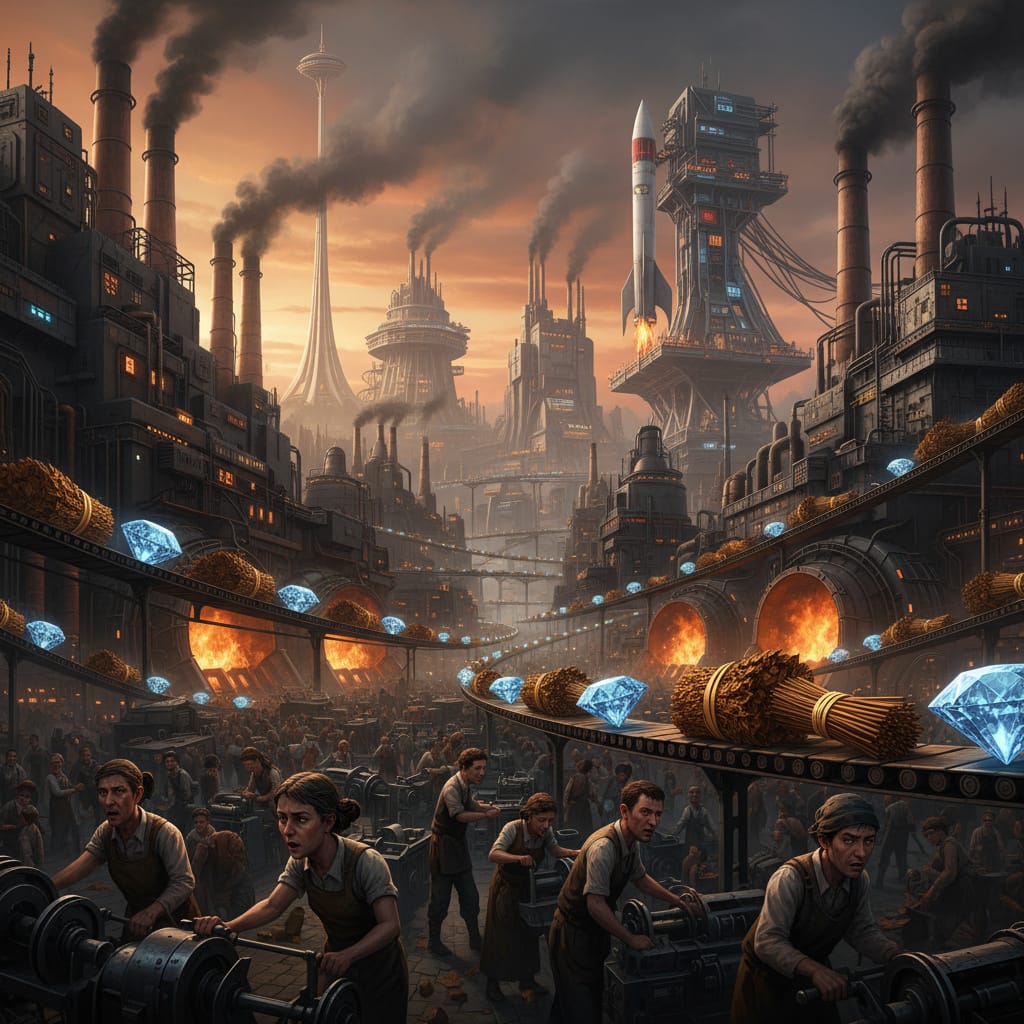
In the intricate tapestry of Civilization VI, every resource, every tile, and every decision contributes to the grand narrative of your empire. Among the most pivotal of these are luxury resources, the traditional bedrock of a happy and contented populace. But what if this fundamental mechanic was upended? Imagine a scenario where every source of Incense, every trove of Diamonds, and every field of Tobacco no longer pacified your citizens with amenities, but instead fueled the roaring furnaces of your industry with raw production. This guide delves deep into the strategic ramifications of such a world, a world where industrial might is directly bartered for citizen happiness.
This shift would fundamentally rewrite the playbook for empire management. The familiar rhythm of expansion, happiness management, and production scaling would be thrown into a new, dynamic disarray. According to the player community, this single change would elevate production to an unprecedented level of importance, forcing a complete re-evaluation of city placement, district planning, and even the very definition of a “good” starting location. Analysis on forums shows that while the potential for an industrial boom is immense, the ensuing amenity crisis would be a constant, looming threat, capable of crippling even the most productive empires. A popular strategy is to embrace this new reality, transforming your civilization into a production powerhouse that can out-build, out-maneuver, and ultimately out-dominate any rival.
The New Calculus of City Development: Production at All Costs
In this altered reality, the value of every tile on the map is re-calibrated. Luxury resources, once a means to an end for managing happiness, become the end itself—a direct injection of production into your cities. This paradigm shift demands a ruthless and calculated approach to city planning, one that prioritizes production above all else.
Re-evaluating Starting Locations and Early Expansion
The opening turns of the game would be a frantic scramble for production-rich territories. A starting location with two or three different luxury resources would be the equivalent of a “god-tier” start in the traditional game. The immediate +1 production from improving a luxury resource tile would be a game-changer in the early game, accelerating the production of everything from scouts and settlers to early wonders.
Many professional gamers suggest that the ideal early-game city would be one that can quickly secure and improve multiple luxury resources. For example, a city settled near a cluster of Cotton, Wine, and Gypsum could, with the right technologies, quickly have three tiles yielding significant production bonuses. This would allow for an explosive start, churning out settlers to claim even more resource-rich lands before your rivals can. The traditional wisdom of settling on a plains-hills tile for the balanced yields would be supplanted by the new imperative: settle near the luxuries.
The Art of City Specialization: Forging Your Industrial Heartland
With luxury resources fueling your production, the concept of city specialization becomes even more pronounced. Cities blessed with an abundance of these resources would be destined to become your industrial heartlands, the engines of your empire.

A popular strategy is to designate these cities as dedicated production centers. Imagine a city with access to four or five different luxury resources. Each improved tile would contribute a steady stream of production, which, when combined with the bonuses from an Industrial Zone and its associated buildings, would create a city capable of building wonders in a handful of turns or raising an entire army in the blink of an eye. These “forge cities” would be the backbone of your civilization, supplying your armies, building your wonders, and fueling your expansion.
The Amenity Crisis: A Looming Threat to Your Empire
The immense production benefits of this new world come at a steep price: a perpetual amenity crisis. With luxury resources no longer providing happiness, your citizens would be in a constant state of discontent, threatening to cripple your empire from within. Managing this crisis would be a full-time job, requiring a multi-pronged approach that leverages every available tool to keep your populace from open rebellion.
The Indispensable Entertainment Complex and Water Park
In this amenity-starved world, the Entertainment Complex and its later-era counterpart, the Water Park, would be elevated from a useful-but-not-essential district to an absolutely critical component of every major city. The Zoo and Arena, once considered modest additions to a city’s happiness, would become the bedrock of your amenity infrastructure.
Analysis on forums shows that the placement of these districts would be a matter of intense strategic calculation. A centrally located Entertainment Complex with a Zoo could provide amenities to multiple cities within its radius, making it a highly efficient solution to your happiness woes. The Colosseum, a wonder that provides a massive burst of amenities to all cities within six tiles, would be a top-priority wonder in the early game, capable of single-handedly stabilizing your empire’s happiness for a significant period.
The Power of Policy and Governance
The right government and policy cards would be essential tools in your fight against unhappiness. The Classical Republic, with its bonus to amenities, would be an attractive early-game government choice. Policy cards like Retainers, which provides an amenity for each garrisoned unit, would become powerful tools for managing happiness in your key cities.
Many professional gamers suggest that a careful selection of policies could be the difference between a thriving, productive empire and a stagnant, rebellious one. As you progress through the civics tree, you would need to be constantly on the lookout for new policies that can bolster your amenity supply. The Liberalism civic, for example, which provides an amenity in every city with a district, would be a major milestone in your quest for a happy and productive empire.

Religion and Great People: Your Saviors in a Time of Need
Religion, often a secondary consideration for many players, would become a powerful tool for managing amenities. A carefully crafted religion with beliefs that provide amenities, such as the Stupa building or the Zen Meditation belief, could provide a steady stream of happiness to your cities.
Great People would also play a crucial role in your amenity management strategy. Great Merchants who provide unique luxury resources (which, in this scenario, would still provide amenities as they are not “standard” luxuries) would be highly sought after. Great Generals with abilities that boost the happiness of your troops could also be a valuable asset, especially during times of war.
Victory in a World of Production: A New Path to Dominance
The shift from amenities to production would not only change the way you manage your empire, but also the way you pursue victory. The traditional paths to victory would still be available, but the strategies for achieving them would be radically different.
The Path of Domination: An Unstoppable War Machine
A domination victory would be the most direct and, in many ways, the most natural path to victory in this new world. The massive production bonuses from luxury resources would allow you to build and maintain a vast and technologically advanced army. Your forge cities would be capable of churning out units at an astonishing rate, allowing you to overwhelm your opponents with sheer numbers.
A popular strategy is to leverage your production advantage to build a diverse and powerful military. You could field large armies of infantry, cavalry, and siege units, all while maintaining a powerful navy to control the seas. The ability to quickly replace your losses would make you a relentless and terrifying opponent on the battlefield.
The Path of Science: A Race to the Stars Fueled by Industry
A science victory would also be well within your grasp. The production bonuses from luxury resources would allow you to quickly build campuses and their associated buildings, accelerating your scientific progress. You could also use your production might to quickly complete the various space race projects, launching your civilization to the stars before your rivals can even get off the ground.
Many professional gamers suggest that a key to a science victory in this scenario would be to balance your scientific and industrial development. You would need to build enough campuses to generate the necessary science, but also enough Industrial Zones and other production-boosting infrastructure to build the spaceports and complete the projects required for victory.
The Path of Culture: A New Renaissance of Art and Industry
A culture victory, while perhaps the most challenging in this new world, would not be impossible. The production bonuses from luxury resources could be used to quickly build theater squares and their associated buildings, as well as the wonders that provide a significant boost to your tourism output.
Analysis on forums shows that a culture victory in this scenario would require a more proactive and aggressive approach. You would need to use your production advantage to not only build your own cultural infrastructure, but also to disrupt the cultural progress of your rivals. This could involve anything from launching targeted wars to steal their great works to using your superior production to build wonders before they can.
A New Era of Industrial Supremacy
The transformation of luxury resources from providers of amenities to purveyors of production would usher in a new era of industrial supremacy in Civilization VI. The game would become a relentless and exhilarating race for production, a constant struggle to balance the demands of industry with the needs of your people. The strategies outlined in this guide provide a roadmap for navigating this new world, a world where the roar of the furnace is the new anthem of civilization, and the path to victory is paved not with gold or faith, but with the sweat and toil of a truly industrial empire. The empires that can master this new reality, that can turn their cities into roaring forges and their people into a disciplined workforce, will be the ones to rise to the top and claim their place as the masters of this new industrial age.