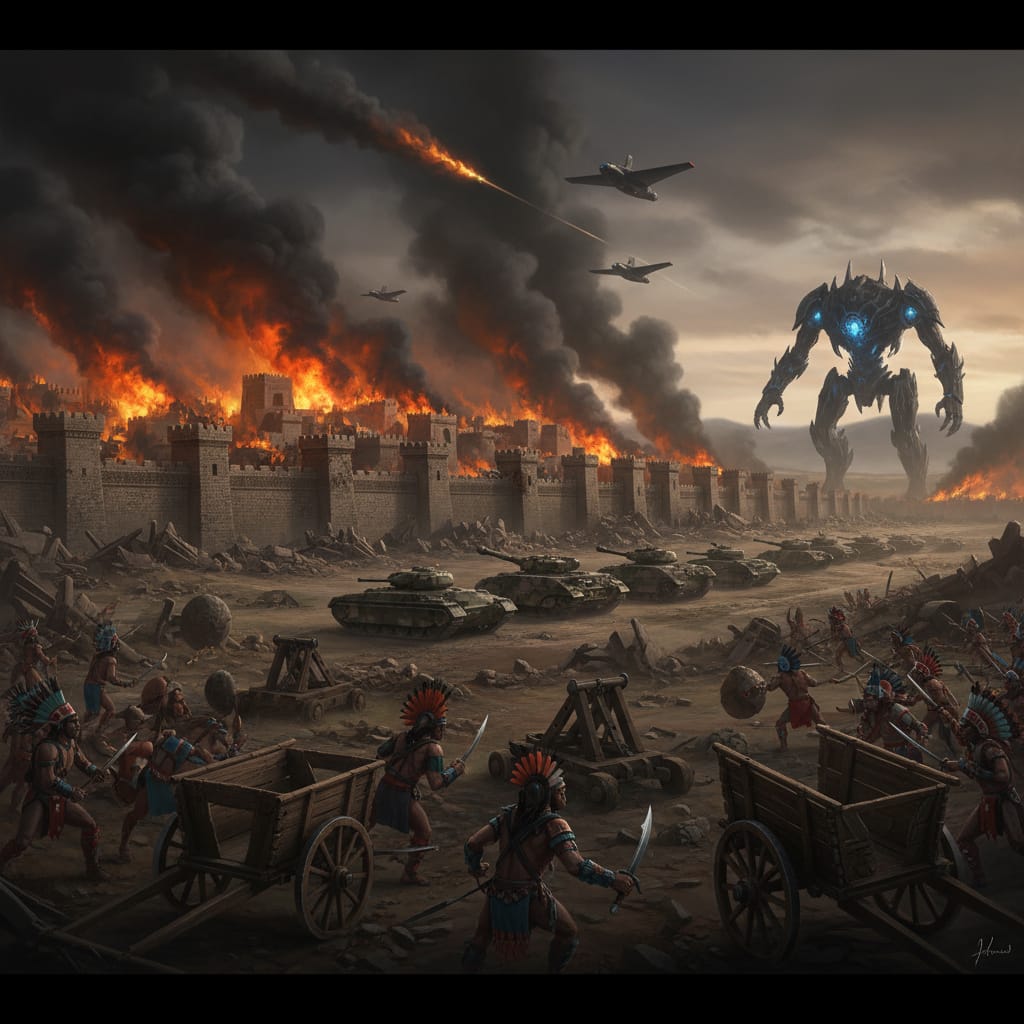
Imagine a world where the very concept of peace is a forgotten myth. A world where every border is a frontline, every neighbor is a foe, and the only diplomacy is conducted through the sharp end of a spear or the roaring cannon of a tank. This is the ultimate stress test of your strategic prowess in Civilization 6: a hypothetical, brutal scenario where all civilizations are locked in a permanent, unending war from the moment they meet. In this unforgiving crucible, traditional paths to victory are closed. There is no scientific race to the stars, no cultural enlightenment, no diplomatic accord. There is only conquest. This guide synthesizes extensive analysis from the player community and professional gamers to provide a definitive framework for not just surviving, but achieving total domination in a world eternally at war.
The New Rules of Engagement: Thriving in Perpetual Conflict
In a world of perpetual war, the standard playbook for Civilization 6 must be thrown out. The gradual build-up, the peaceful expansion, the careful balance of yields—these are luxuries of a bygone era. From turn one, your civilization must transform into a finely tuned war machine. Every decision, from the placement of your first city to the direction of your initial research, must be geared towards immediate military advantage.
Analysis on forums shows that the most successful players in this scenario adopt a “shark” mentality: move or die. Stagnation is a death sentence. Your first priority is not a monument or a granary, but a warrior, a slinger, or your civilization’s unique early-game unit. Scouting is not just for discovering tribal villages and natural wonders; it is for identifying your nearest rival and assessing their military strength. The moment you encounter another civilization, the war begins, and you must be ready.
A popular strategy is to forgo the development of a balanced, aesthetically pleasing empire. Instead, your civilization becomes a network of military bases and production centers. Cities are not founded for their access to luxury resources, but for their strategic position as a forward operating base for an upcoming invasion. The player community suggests that a “forward settle,” placing a city provocatively close to a rival, is not a risky gamble in this mode, but a standard opening move. This city will serve as a vital staging point for your units to heal and reinforce, strangling your opponent’s expansion and providing a launching pad for your assault.
Tier One Civilizations: The Apex Predators of Eternal War
While any civilization can be led to victory in the hands of a skilled player, the unforgiving nature of permanent war heavily favors those with early-game military advantages. Player analysis consistently points to a select few civilizations as the apex predators of this brutal environment.
Sumeria (Gilgamesh): Widely regarded as the undisputed king of early warfare, Sumeria is tailor-made for this scenario. Their unique unit, the War-Cart, is available from the start of the game and requires no strategic resources. It is stronger and faster than the warrior, and suffers no penalties against anti-cavalry units. A swarm of War-Carts in the ancient era is a nearly unstoppable force. Furthermore, Gilgamesh’s leader ability encourages aggressive alliances (which are impossible in this scenario, but the pillaging bonus is still relevant) and shared experience points for units fighting together, allowing your army to level up with terrifying speed.

The Aztecs (Montezuma): The Aztecs are another top-tier choice for their ability to turn war into economic growth. Their Eagle Warrior, a replacement for the warrior, is stronger and has a chance to capture defeated enemy units and turn them into builders. This unique ability allows you to fuel your expansion and infrastructure development by simply fighting. Conquering a city and immediately having a host of builders to repair and improve it is an advantage that cannot be overstated. Montezuma’s ability to use luxury resources to increase the combat strength of his units further incentivizes aggressive expansion.
Macedon (Alexander): Alexander is a snowballing force of nature. His civilization is designed to chain conquests together. Upon capturing a city with a wonder, his units heal completely, allowing them to continue their rampage without pause. Furthermore, Macedon gains science and culture from capturing cities with specialty districts, meaning that your military conquests directly fuel your technological and civic advancement. This allows you to focus your cities on pure production, knowing that your warmongering will keep you competitive in the tech race.
Scythia (Tomyris): For players who favor a cavalry-based approach, Scythia is a nightmare for its opponents. Tomyris’s ability to produce two light cavalry units or Saka Horse Archers for the price of one allows you to build a massive, mobile army with astonishing speed. Her units also heal upon defeating an enemy, making them incredibly resilient in the field. A Scythian horde in the early game can cover vast distances and strike with overwhelming force, making them a terrifying neighbor in a world without peace.
The War Economy: Fueling the Eternal Conquest
A world at war is a world of scarcity. Your ability to produce and maintain a large, technologically advanced army is the single most important factor in your survival. This requires a ruthless and efficient war economy.
Production is Paramount: Every city you found must be a production powerhouse. Settle near hills for mines, and prioritize the construction of Industrial Zones with maximum adjacency bonuses. Many professional gamers suggest using internal trade routes not for gold, but to send food to your production-heavy cities to ensure their continued growth. Policy cards that boost production, such as Agoge (+50% production towards ancient and classical era melee and ranged units) and Maneuver (+50% production towards ancient and classical era light and heavy cavalry units), are not optional; they are essential.
Pillaging is Your Primary Income: In a permanent war scenario, pillaging is not just a bonus; it is a core economic pillar. Raiding enemy tile improvements provides gold, science, culture, and faith. A popular strategy is to use fast-moving units, like cavalry, not to attack cities directly, but to sweep through an enemy’s heartland, crippling their economy and fueling your own. The gold gained from pillaging will be essential for upgrading your units and supporting your army’s maintenance costs.

The Science of Destruction: Prioritizing a Deadly Tech Tree
While brute force is important, a technologically superior army will always have the upper hand. In a world of perpetual war, your science path must be a direct line to the most destructive military technologies available.
The Beeline Strategy: The player community overwhelmingly advocates for “beelining” key military technologies. This means focusing all of your science output on a single tech, ignoring others that do not contribute to your immediate military needs. In the early game, this means rushing Bronze Working for swordsmen, Archery for archers, and Horseback Riding for cavalry. In the mid-game, the focus shifts to Machinery for crossbowmen, Stirrups for knights, and Siege Tactics for trebuchets.
Siege is Everything: Taking down city walls is the great filter of domination. An army without siege equipment is a stalled army. Battering rams are essential in the ancient and classical eras, while catapults and trebuchets become necessary as cities develop stronger walls. A popular strategy is to have a dedicated corps of siege units that follows your main army, ready to break down enemy defenses. Later in the game, bombards and artillery become the keys to unlocking even the most fortified cities.
Culture and Control: The Unseen Frontline
Conquering a city is only half the battle. Holding onto it is a different challenge altogether. In a world at war, loyalty is a constant struggle. A newly conquered city, surrounded by enemy territory and suffering from war weariness, is a ripe target for rebellion.
Governors as Peacekeepers: Governors are your primary tool for maintaining loyalty. Victor, with his Garrison Commander promotion, is an excellent choice for a newly conquered city, as he provides a significant loyalty boost and strengthens your garrisoned unit. Amani, with her Emissary promotion, can also be used to exert loyalty pressure on surrounding cities, potentially causing them to flip to your side without a single arrow being fired.
Policy and Propaganda: The right policy cards can make all the difference in holding your empire together. Limitanei (+2 loyalty per turn for cities with a garrisoned unit) and Praetorium (+2 loyalty per turn in cities with a governor) are essential for maintaining control. The “Bread and Circuses” city project, available in cities with an Entertainment Complex, is a powerful tool for increasing loyalty pressure in a region, helping to solidify your hold on a conquered territory.
Advanced Tactics for a World at War
As the game progresses, the nature of warfare evolves. To remain a dominant force, you must adapt your strategies and embrace new technologies of destruction.
The Great Generals: In a world of constant conflict, Great Generals are not just a bonus; they are a necessity. Their combat strength aura can turn the tide of a battle, and their unique retirement abilities can provide powerful, game-changing advantages. Actively pursuing Great General points through Encampment projects is a high-priority activity.
Naval Dominance: On maps with significant bodies of water, a powerful navy is essential. A fleet of frigates and battleships can project power across the globe, allowing you to strike at opponents on distant continents. Coastal cities, often the most populous and developed, are particularly vulnerable to naval assault.
The Late Game Annihilation: The late game introduces the most powerful units in Civilization 6. Airpower, in the form of bombers, can reduce enemy cities to rubble with impunity. Tanks become the new cavalry, capable of blitzing through enemy lines. And for the ultimate expression of military might, the Giant Death Robot is a walking apocalypse, capable of single-handedly destroying entire armies. A popular strategy is to prepare for these late-game transitions by building up your science and production, ready to unleash a new wave of destruction on a world that has known nothing but war.
The Last Capital Standing
A Civilization 6 game of permanent war is a brutal, relentless affair. It is a test of pure military and economic efficiency. The strategies outlined in this guide, synthesized from the collective wisdom of the player community, provide a roadmap to victory in this chaotic scenario. By embracing a mindset of total aggression, choosing the right civilization, building a powerful war economy, and mastering the arts of siege and control, you can rise from the ashes of a world eternally at war and stand alone as the last capital standing. The path is paved with the ruins of your enemies, but for the victor, the spoils are absolute.